The eternal emperor's road from glory to ashes









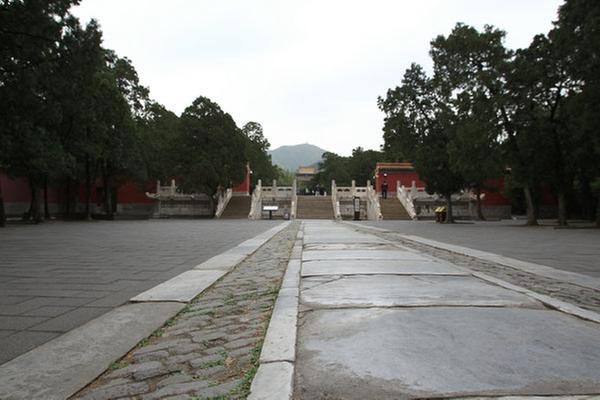 |
| Dingling Mausoleum, the final resting place for Emperor Wanli (1563-1620). [Photo provided to China Daily] |
Succession issue
A lingering issue during his reign concerned the choice of his successor, the crown prince. While the emperor favored his third son, the court and his mother sided firmly with his eldest one. The political struggle went on for nearly 30 years. The emperor protested by refusing to attend daily court meetings, but in vain. In 1601, Changluo was made crown prince. But it was only in 1614, six years before Wanli's death, that the emperor finally ordered-certainly against his own will-the dispatch of his third son from Beijing, the Ming capital, to his own fiefdom thousands of kilometers away. (The threat was removed, finally.)
How much did this saga, straddling nearly three decades, affect Emperor Wanli? No one can know, but the emperor's protest turned into a habit. For nearly 30 years before he died he lived a reclusive life with his many royal concubines in the Forbidden City, a sprawling imperial residence for Chinese emperors from the early 15th century. From this center of power he ruled his vast country mainly by edict or giving written replies to any state affair put forward by his ministers for consideration.
The emperor was certainly neglectful in many ways, with at least one exception: building his final resting place.
Construction of the Dingling Mausoleum began in 1584 when he was just 22 and two years after the death of Zhang, his powerful consul. (Zhang, known for his prudence, may have objected to the idea if he had been alive.)
It would last for six years, with total spending exceeding the state's tax income for two consecutive years. The mausoleum, covering 182,000 sqm, was designed symmetrically. Along the central axis one can find in turn the grand entrance of the mausoleum, three courtyards, a stone tower and finally the burial mound under which the emperor's secret chamber lies. All the buildings face southeast.
Encompassing everything is an outer wall, long since reduced to mere foundations. Despite the will of the emperor, the mausoleum was not spared the ravages of time.
Hu Hansheng, a historian who specializes in imperial Ming tombs, says large-scale damage was first wreaked on the mausoleum in 1644, when an army led by the peasant rebel leader Li Zicheng entered Beijing. Before the wooden palaces of the mausoleum were set on fire, Emperor Chongzhen, the last emperor of the Ming Dynasty, had hanged himself on a tree in his royal garden.
"That was 54 years after the completion of the Dingling Mausoleum and 24 years after the death of Emperor Wanli."
Yet the rebel leader Li failed to hold on to power. The Manchus, a nomadic people from northeastern China, defeated his army soon after and set up the Qing Dynasty (1644-1911), China's last feudal dynasty.
"Despite common belief, the Qing rulers in fact exhibited great sensitivity when it came to their Ming predecessors," Hu says. "Ming mausoleums destroyed in 1644 were reconstructed, although on a shrunken scale."