



The eternal emperor's road from glory to ashes









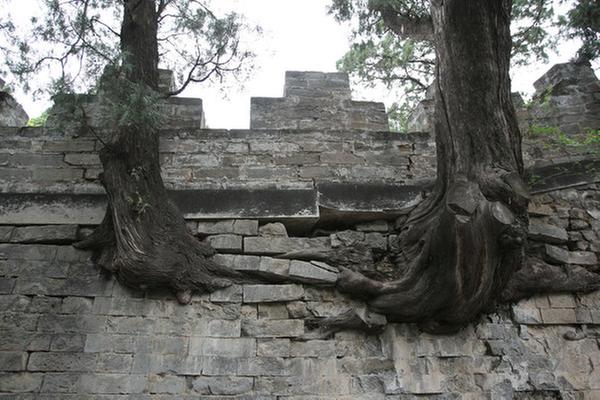 |
| The trees on the wall of ming lou, or Worldy Tower. [Photo provided to China Daily] |
Thinking big
When Emperor Wanli first decided to build a grand mausoleum for himself, he solicited opinions from his chief officials at court. One answered: "With Zhaoling Mausoleum standing not far away, it would be utterly improper to build anything more grandiose than that." Zhaoling is the burial ground for Wanli's father, Emperor Longqing, who was only on the throne for five years before death.
But Wanli refused to listen. What he had in mind was the magnificently constructed mausoleum of his grandfather, Emperor Jiajing. Jiajing reigned for 44 years, four years less than Wanli. Yet the comparison does not end there-both emperors were known for their cavalier neglect of duty, coupled with excessive lifestyles that suggest both had embarked on paths of despairing self-destruction.
Yang Shi says the emperor's life of abandon led Wu Han, a leading historian behind the excavation, to request a scientific examination on the emperor's remains to see whether he had contracted any sexually transmitted disease. It was never performed.
Defenders of Wanli have always argued that the emperor, despite all his self-indulgence, was a man of military genius. Between 1592 and 1598 he sent troops into Korea, to protect that then vassal state of his empire against the invading Japanese under Toyotomi Hideyoshi. The military triumph of the Ming army not only saved Korea, but also contributed to the fall of the court of Toyotomi, 17 years after Hideyoshi's death. Wanli is believed to have personally directed the campaigns, by issuing orders from the depth of the Forbidden City, of course.
However, the emperor savior, regarded as a hero by his neighbors, has long been blamed for the demise of his own empire. It seemed that his long and largely negligent reign sapped the last remaining energy from his family's rule of more than 200 years.
According to Ming's own official history, because of the chaos following his death in 1620, the coffins of Wanli and his empresses had to wait for months before being taken to the burial ground the emperor had built for himself three decades earlier.
When the excavation team finally entered the underground burial chamber in 1957, they found some wooden funerary chests lying right beside the coffins. On them were marks left by ropes once used by carriers to tie the chests. In some cases, wooden sticks used for carrying were simply left there.
"The burial must have been done in great haste," Hu says.















