


Young Cantonese storytelling enthusiast helps stem decline of intangible cultural heritage
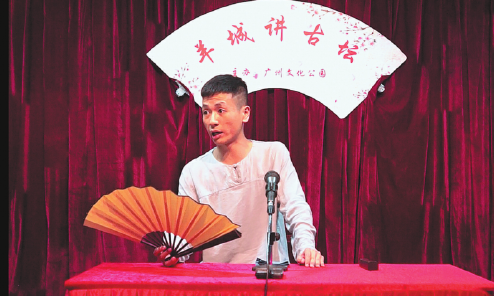
Peng Jiazhi, 28, stages Cantonese storytelling performances in a chess room at Guangzhou's Cultural Park every Monday morning.
During each performance, he speaks about 24,000 Chinese words in two hours, using varying pitch, facial expressions, gestures, an eye-grabbing board and a folded fan to convey scenes mostly from ancient stories, such as Heroes in Sui and Tang Dynasties and Romance of the Three Kingdoms.
He may seem young to be teaching others the art of Cantonese storytelling performance, a provincial intangible cultural heritage, but his passion for the art since childhood has made him the ideal person to carry on the tradition.
During his childhood, Peng, a Guangzhou native, heard stories from his grandmother about the Japanese bombing the city and from his grandfather about ancient legends and his own experiences. Combining this with information from books and audio resources, he retold stories to his classmates during breaks at school.
When he was 14, after reading that master Yan Zhitu had resumed Cantonese storytelling performances after the media brought attention to the decline of the tradition, Peng decided to become a disciple of Yan. He took it up as a profession after university.
Cantonese storytelling requires four basic skills - writing, speaking, performing and commenting.
"In commenting, a storyteller combines his own thinking with the stories. It is the highest requirement," Peng said. "In telling Romance of the Three Kingdoms, for example, different people express varying thoughts. People with different values make different comments."
To prepare for a performance, he might need to read many versions of the story, talk to an expert on ancient weapons, walk along local roads depicted in the story, and develop gestures. On stage, he occasionally adds impromptu touches by making humorous references to current affairs.
Mastery lies in the detail. For example, a character might stroke his beard in unique way, a technique employed in Cantonese Opera.
To learn about the gestures used in the traditional art form, Peng studied under Bai Yunfeng, a Cantonese Opera master.
Peng is the youngest of the three Cantonese storytellers still performing, with his masters Yan Zhitu and Yao Huanran in their 70s. The audience consists mainly of elderly people and children.





