


Survey and industrialization
Yunnan is known for its biodiversity with its mountains, rising more than 5,000 meters, and lush plains.
"Mountainous areas account for 94 percent of Yunnan's land. If we can develop new medicines, herb planting in rural areas can be strengthened. In this sense, the local economy can get a boost when our medicines are sold all over the world," Zhu said.
However, ethnic medicines are not well-known in the outside world. But the knowledge and expertise behind them are deeply rooted in local culture and should be cherished as unique and precious resources, Zhu said in one of her books The Innovative Development for Ethnical Medicines.
"Many fine medicines created by China's ethnic groups have not been developed and my responsibility is to promote them," she said. "We also want to bring them to the global market as well."
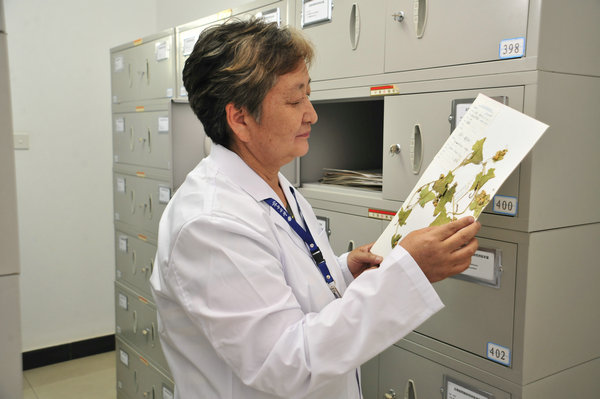
Innovation has been one of her priorities since she led a team, for the first time, to complete a wide-ranging survey on Yunnan's natural medicines.
Zhu's team collected more than 80,000 samples for more than 10,000 medicinal substances. About 160,000 pictures were taken to record original conditions.
She also chaired the compilation of the nine-chapter Illustration on Yunnan's Natural Medicines and other two books on medicine, to support the protection, research and development of such medicines. As the first author, Zhu was picked by the central government for the 2012 National Science and Technology Progress Award.
Based on the surveys, the institute accelerated the industrialization of ethnic medicines. Zhu and her team compared thousands of prescriptions and trialed medicinal materials to make a slew of Yi-ethnic-group medicines. Five of them were approved and patents were granted to six medicines.
Over the decades, the institute's researchers have left their footprints all over the province as they visited ethnic doctors and translated medical books. The efforts resulted in three databases to record more than 4,000 medicines.
"My team has found how to develop ethnic medicine mainly in three key steps; resource surveys, standardized research and then industrialization," she said.





