


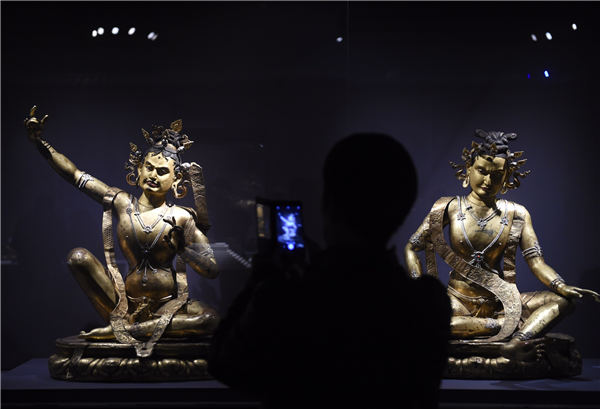
A huge embroidered thangka from Jokhang Monastery on Yamantaka, a Tibetan Buddhist deity, is one of just three surviving works in the world, and clearly indicates the reign of Emperor Yongle in the Ming Dynasty (1368-1644).
A similar thangka in a private collection was sold for 310 million yuan ($49 million) at an auction in Hong Kong in 2014.
The earliest woodblock printed Buddhist scripture in Tibetan, also from Yongle's time, is also on display.
The edition was printed in Nanjing, capital of Jiangsu province, following an edict and the emperor wrote the preface for it.
Speaking about other religious relics, Zhang points to an 8th century gold-gilt statuette of Gautam Buddha featuring an art style found in Kashmir, where the facial lines also show Greek influence.
Also on display is a silver kettle from Jokhang Monastery - a holy item for pilgrims - decorated with images, which are believed to have originated in West Asia.
Despite the focus on Buddhism, Zhang says the exhibition also tries to go beyond the period when the religion dominated Tibet, and tries to focus on the early history of the land. Major archaeological discoveries in Tibet in recent years are also being showcased.
For instance, the earliest found remains of tea leaves in China and silk pieces featuring the Chinese characters wang hou (prince and marquis), which were unearthed in Ngari prefecture and date back to the third century AD, show communication between Tibet and the inland areas, and are being showcased at the event.
A gold mask used for burial, also from the same period in Ngari, is linked to the Zhangzhung kingdom, and echoes customs of grassland civilizations across Eurasian lands.
"We want to correct a common stereotype that Tibet was a relatively inaccessible place in ancient times due to harsh geographic conditions," Zhang says.
"There was a branch of the ancient Silk Road route on the plateau. And it facilitated frequent cultural communication between Tibet and the outside world."
After all, while Lun Dongzan in Bunian Tu wore clothes from Sogdian (an ancient Iranian civilization) when meeting a Tang emperor, how can you believe that Tibet did not embrace different cultures in ancient times?
If you go
Tibet History and Culture
9 am-5 pm, closed on Mondays, through July 22 (some exhibits will be displayed for a shorter period). Entry is free of charge but online or phone reservation for the exhibition is needed (at least one day in advance). Hall B, 1st Floor, Capital Museum, 16 Fuxingmenwai Avenue, Xicheng district, Beijing. 010-6339-3339. www.capitalmuseum.org.cn





