


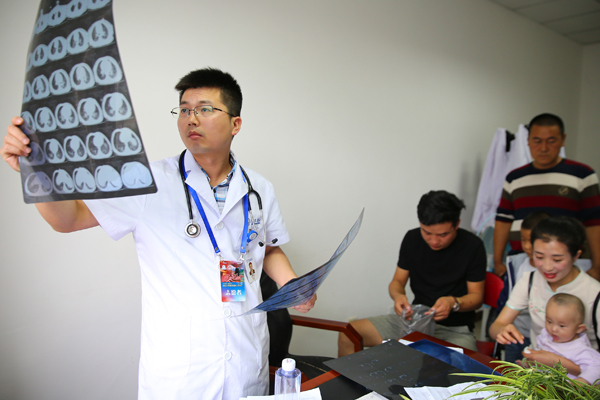
Health awareness
Zhugqu county in Gannan Tibet autonomous prefecture is located in southern Gansu province, about eight hours' drive from Lanzhou, the provincial capital.
Lying amid lofty mountains and with the Bailong River winding through, the county seat is frequently shrouded in mist. The rural county is familiar to the majority of the Chinese population after deadly landslides claimed more than 1,700 lives there in 2010.
It's still hard to identify whether the incidence rate of congenital heart problems in Zhugqu is higher than in other areas of China, Li says.
Chen Guocai, a volunteer doctor at the county hospital, believes the general trend is that the incidence rate is higher in western China than in central and eastern China, and that it is more prevalent in rural areas than in urban areas.
However, as a doctor with around 10 years' experience of working in volunteer medical missions in rural areas around China, Chen Hao admits that the situation in Zhugqu is more pronounced.
Congenital heart problems, contrary to the common view held by many locals, are not necessarily hereditary.
The high altitude in Zhugqu, ranging from around 1,000 meters to more than 4,500 meters, may partly account for the phenomena. A lack of oxygen in the air may contribute to a higher risk of fetuses suffering from a lack of oxygen in the womb and the arrested development of their cardiovascular systems, according to Chen Guocai.
In Chen Hao's view, pregnant women in rural areas like Zhugqu may not be able to gain adequate levels of nutrition as they are also not aware of how to properly take care of themselves during pregnancy.
For example, catching a cold during the first three months of pregnancy significantly raises the risk of infants developing congenital heart disease.
There also are hundreds of specific types of congenital heart problems. A few can spontaneously heal themselves, while the majority of them can be treated with major surgery.
For some certain complex cases where no effective radical cure is possible, palliative operations are able to relieve the pain, prolong life and greatly improve the patients' quality of life.
To this end, the country's civil affairs department has been supportive in treating congenital heart problems. In Gansu province, a considerable part of the costs are being covered by the serious illness insurance plans offered under the province's social insurance system.
As for impoverished patients, the local civil affairs department is offering its support to ensure patients pay no more than 3,000 yuan ($440) each year for the treatment of serious illnesses.
The department will cover the extra medical costs beyond 3,000 yuan after the reimbursement of serious illness insurance and other commercial insurance policies.
However, as local hospitals in Zhugqu have neither the doctors to perform the surgery required for serious heart problems, nor the necessary operative facilities, patients have to leave the area to receive surgery, incurring extra costs for transportation, accommodation and food.
And as more patients and their families attend top hospitals in cities like Beijing for the treatment of complex cases, the amount of money that can be covered by insurance drops considerably and the procedure of reimbursement becomes more complicated.
According to Li Xiaojuan, director of the local health department, 12.3 percent of the county's poor population have some form of serious illness, while 19 percent suffer from a disability.
Postoperative care also has the potential to bring down a family's living standards.
Li Wenjuan says the local health system has been actively publicizing basic information about congenital heart problems via the local media and social network platforms like WeChat and QQ.
Some family physicians and government officials also visit patients' homes to suggest possible solutions to their conditions face-to-face.
In general, as patients in families with children become increasingly aware of congenital heart problems, more of them are actively seeking treatment-which in turn is leading to an improvement in the situation.
And this trend is likely to continue as access to free consultations and treatment grows from a variety of sectors such as hospitals, related health enterprises and philanthropic organizations.
According to Zhao Tao, secretary-general of the organizing committee of "Chinahearts", they have sponsored more than 1,300 children patients with congenital heart problems to receive surgical treatment during the past decade and around 100 more will be funded this year.
Contact the writer at fangaiqing@chinadaily.com.cn





