



'Seawater rice' rides tide of hope and hype









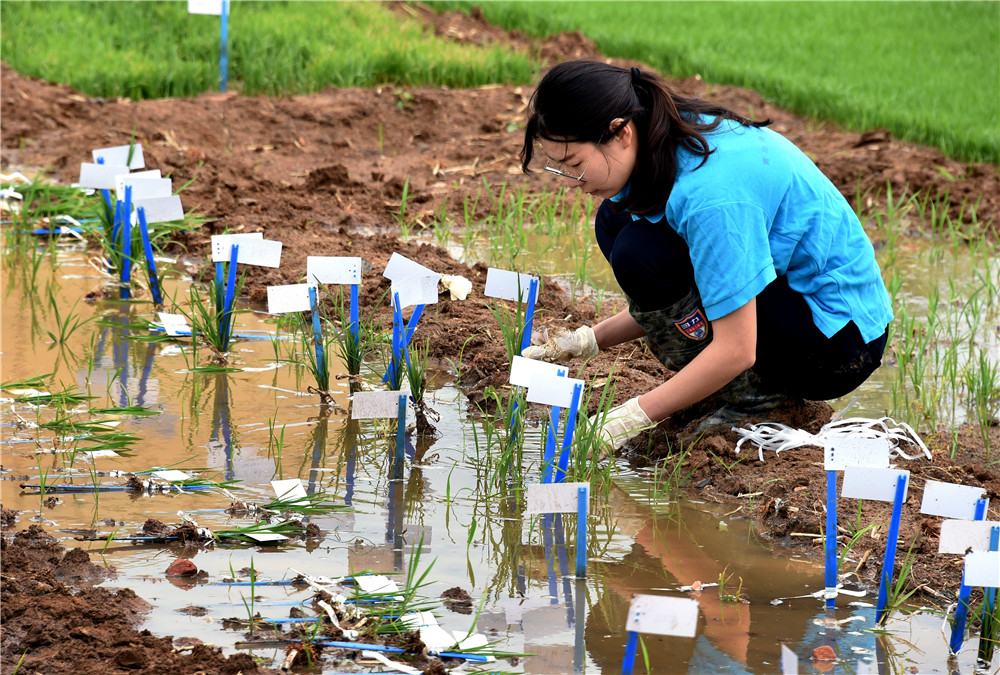
The efforts of Yuan and Chen to develop salt-resistant rice have attracted a lot of praise on social media, but many Chinese experts have cautioned that their work is still in its infancy.
In mid-July, Science and Technology Daily cited rice expert Ling Qihong as saying in an academic article in the periodical China Rice, which is sponsored by the China National Rice Research Institute, that it is difficult to plant rice on a wide range of wasteland and there is still a long way to go.
Media attention
Ling said China had accumulated rich experience in cultivating rice on saline and alkaline land, but the breakthroughs in salt-resistant rice strains could not deny the role fresh water from irrigation played in leaching out salt.
"It also depends on long-distance transportation of huge amounts of fresh water, which is time-consuming and a big project," Ling wrote, adding that the name "seawater rice" could cause misunderstandings. After learning that salt-resistant rice was irrigated by diluted seawater on the Qingdao experimental paddies, Ling said it was not right to call it "seawater rice".
In a more recent report in Science and Technology Daily, another plant breeding expert, Li Liqiu, echoed Ling, describing the name "seawater rice" as a stunt designed to maximize media attention.
Researchers from the Qingdao center said Ling's opinion was based on the early stage of salt-resistant rice research.
Zhang said the research team has developed a core technology called the "four-dimensional optimizing method" which tailors solutions for different soil types by taking advantage of the internet of things, soil conditioner, plant growth regulator and the rice's resistant capabilities.
Ling also cited Dai Qigen, a professor from the College of Agriculture at Yangzhou University, as saying that rice only survives in water with a salt content no higher than 0.3 percent.
Zhang said Dai's conclusion was out of date, and the Qingdao center's new salt-resistant species had lifted the tolerable salt content to 0.6 percent.


- Serbian president meets HBIS chief, backs green steel push in Belgrade
- Chinese-built cruise ship passes sea trials
- Senior Jiangxi official Li Wei investigated for discipline violations
- Guangzhou launches latest affordable housing scheme
- Shandong capital unveils Novi Sad-inspired sister city garden
- China's port throughput expands in early 2026 on strong container growth





