


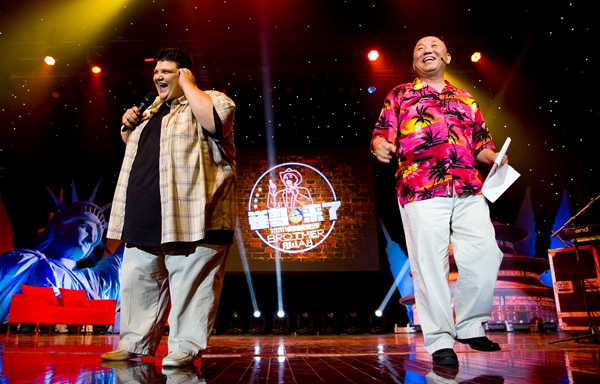
Every Saturday night, a small theater called Xigua, or "watermelon", capable of seating an audience of about 80 and located in Yongqing Fang-century-old alleyways in the southern Chinese city of Guangzhou-is packed to the rafters.
Three or four stand-up comedians walk on the stage one after another and tickle the funny bones of the audience during a show that lasts an hour and 30 minutes. This would have been unthinkable just a few years ago
"If you think what the performers say is funny, laugh out loud; but if it sucks, just heckle them with your applause," says a comedian, surnamed Ji, when warming up the audience at the beginning of a show.
With Ji having barely finished speaking these words, the whole arena burst into applause, cleverly playing along with the joke.
Difficult start
In the metropolis, which has few theaters for stand-up, shows in both Mandarin and Cantonese total no more than 20 a month, with the ticket prices generally less than 100 yuan ($14.2).
"When we first started out, there was one time when we had only two people in the audience, but 10 comedians backstage," Ji tells the audience during a break in the show.
By any measure, the ticket sales from the shows were not enough to support a single performer in a small theater.
"So most of us are part-time performers," says Pi Qiu, a comedian and the head of a stand-up comedy club named Douban in Shenzhen.
He recently delivered his routine on the latest season of Rock &Roast, one of the most popular TV shows of its kind in China.
"If I were known to a wider TV audience, maybe there would be more people to watch our live shows," he says, explaining his rationale behind performing on TV.
Li Dan, one of the most famous Chinese stand-up comics, and a planner on the show, admitted in the program that while he is now well-known to the public through stand-up, this form of performance is still limited in China.
Stand-up comedy, which originated in Europe and North America, is quite young in China, with "open mic" shows first appearing in pubs in Beijing and Shanghai in 2009. Audiences in Guangdong came to it much earlier as it was first introduced to neighboring Hong Kong in 1990.
Dong Jiama, born in 1990 and deeply influenced by Cantonese stand-up comedy, discovered that ordinary people could perform stand-up when he read online about a show at a Guangdong club in 2014. He began to perform onstage and started a stand-up club called Banana with his friends in 2015.
Despite the fact that their initial audiences, basically locals in Guangzhou, often posted numbers in the single digits, the industry gained more attention after a number of TV shows related to stand-up became popular in China in 2017.
Since then, their audience has steadily grown and now each of their formal performances, on average, attracts around 50 audience members. Sometimes, people will travel from other cities just to catch their show.
Meanwhile, their performance venues have moved from coffee shops, pubs and bookstores to a small theater, which is a more stable and formal venue for performing.
Show must go on
As one of the Banana club's founders, Fang Yu used to work for a well-known technology company in Shenzhen. His past work experience, workplace relationships and overtime are all fodder for his jokes.
Such stand-up material based on reality has become hugely popular among young people in China.
"All of our jokes come from our own lives and resonate with the audience. Only when you come to the club and interact can you feel its true charm," says Liang Xiwei, a comedian at the club.
With Chinese people spending more money than ever on live entertainment amid booming development of the culture industry, Dong and his friends are looking for some bigger venues. To them, a bigger audience means better performances and higher returns, instead of more stress.
Many stand-up comics like to prepare all-new material for each performance, and they see it as a minimum requirement for the mastery of their art. Despite being busy with formal performances now, members of the Banana club still like to hone their craft with peers from other local clubs, seeking inspiration and continuing to host and perform "open mic" nights to test out new material.
However, in Dong's eyes, there remains considerable room for improvement in the country's stand-up industry. "To attract bigger audiences, we should localize our stand-up in content, form and even rhythm."
Stand-up comedy attaches great importance to originality, but protection of original work is not easy. The comedians must strike the difficult balance between promoting their shows online and risking having their jokes plagiarized.
"We welcome you to post pictures from the show online, but no audiovisual recordings please," Ji requests of the audience at the beginning of the show.
Stand-up caters more to young people, most of whom are between the ages of 20 and 35, according to data from Pi Qiu's club.
Despite their struggles, even scattered laughter from the audience is enough to give the performers confidence to keep going. "After all, making people laugh is what it's all about," says Liang.





