


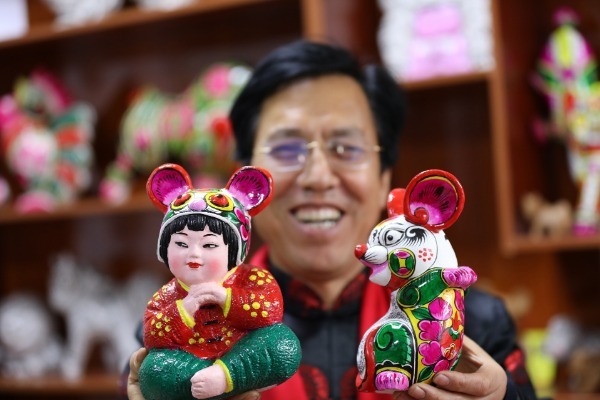
Craftsman Hu Xinming's clay sculptures usually revolve around traditional Chinese cultural themes. But these days, his work has taken a new direction: fighting drug crimes.
Hu, 55, is a national-level inheritor of the intangible cultural heritage -- Fengxiang clay sculpture, a traditional folk art that originated in the county of Fengxiang, Northwest China's Shaanxi province.
Lately, he created a work for police officers: clay sculpture of an ox trying to pluck poppy flowers from the earth.
The sculpture was made specially for this year's International Day Against Drug Abuse and Illicit Trafficking, which falls on June 26.
The sculpture has been printed on postcards and is being promoted by police to spread anti-drugs awareness in Xi'an, capital of Shaanxi.
Fengxiang clay sculpture
Fengxiang clay sculpture, better known as "the clay stuff" by locals in the county, originated during the pre-Qin period (pre-221 B.C.) and thrived in the Ming Dynasty (1368-1644).
The sculptures are fashioned from the unique earth found in Liuying Village in the county of Fengxiang. Artists like Hu knead the earth, whiten the clay, paint lines and add colors, before finishing the sculptures.
"Fengxiang clay sculptures were first used for sacrifices during the period of Duke Xian of Qin, replacing human beings to be sacrificed for deceased royals," said Hu. "In the Ming Dynasty, the clay sculptures were no longer the prerogative of the royals and became common possessions."
The craft was included in a national protection project for intangible cultural heritage in 2006.
Hu started making the clay sculptures as a child in Liuying Village, learning techniques from his parents who were both masters of the craft, paper-cutting and embroidery.
Currently, hundreds of families in the village make a living by making the sculptures. Every year, countless clay works are exported.
"I feel the responsibility to help pass on the traditional culture," Hu said.





