



Renewed sense of purpose









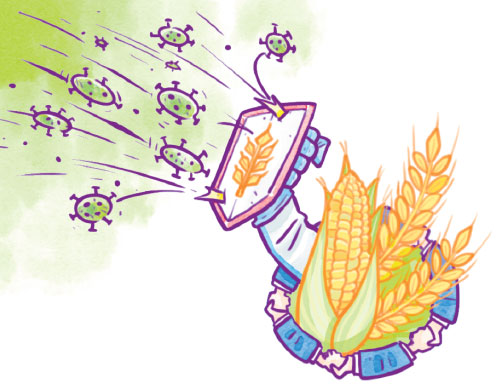
Pandemic has shown that the mission of the FAO is as relevant now as the day it was founded
When I took over as director-general of the Food and Agriculture Organization of the United Nations last year, I could barely contain my emotion. The FAO's foundation, after all, had preceded-if only by a matter of days-that of the UN itself. That I, born into a Chinese farming family, would come to lead such a venerable institution was awe-inspiring.
What I did not expect was that a short while into my tenure, the world would be confronted with a challenge on a scale not seen since the end of World War II. The novel coronavirus outbreak has not only taken a toll on human lives and health, it also threatens the livelihoods of hundreds of millions of people around the world. Food security, until recently a rather foreign concept to many living in well-to-do countries, has made headlines worldwide and claimed pole position on the agenda at many high-level events.
But let's return to 1945, the year the FAO was founded. One-third of the victims of World War II died of malnutrition and associated diseases. Famines had decimated populations over the previous decades, so nations came together, and the FAO was established on Oct 16, 1945. Its founders invested in the new institution the world's aspiration-to help the world rebuild and expand agriculture, and to end hunger forever.
Today's crisis may be less tangibly apocalyptic. But the numbers are no less staggering. Even before the pandemic, nearly 700 million people were undernourished. The economic disruption linked to the pandemic may add another 130 million or so to these. In the early days of the pandemic, when shelves went empty, when fruit-pickers went missing, when markets fell silent, we realized that we were taking these services, and the people that provide them, for granted. The moral imperative to feed the world-safely, durably, with dignity for all-is as urgent now as it was after the war.
I am aware, as I write these lines, that the analogy with 1945 can only get us so far. Back then, the crisis was one of production. The FAO's first years were largely focused on expanding the output of farms, boosting yields, supporting plans for mechanization and irrigation. Over subsequent decades, this vision became immensely more complex, enriched with environmental and sustainability concerns. A more holistic understanding of development set in. Until the mid-2010s, the world was making impressive progress in reducing hunger. But it has since been rising again. Conflict and extreme weather patterns are to blame, at least in part.
What we now need is smart, systemic action to get food to those who need it and improve it for those who have it. Action to prevent crops from rotting in the field, for lack of efficient supply chains. Action to enhance the use of digital tools and artificial intelligence, so as to predict threats to harvests, automatically trigger crop insurance and cut climate risk. Action to rescue biodiversity from relentless erosion. Action to turn cities into the farms of tomorrow. Action by governments to implement policies that make healthy diets more accessible. Action by agencies like mine to turn think tanks into action tanks rolled into one, linking the research community with the private sector to unleash the power of innovation.
So at 75, the FAO is far from thinking it can ride off into the sunset. We are not day-dreaming either. The novel coronavirus has made it abundantly clear that our mission is as relevant today as when our founders created the FAO in 1945. Cataclysms spur renewal. The pandemic has reminded everyone that food security and nutritious diets matter to all.
This is why the FAO is today embarking on the next chapter in its story with a renewed sense of purpose. On the structural side, a flatter leadership structure and a modular approach allow for a more rapid reaction when crises hit. A comprehensive and holistic COVID-19 Response and Recovery Programme proactively and sustainably addresses the socioeconomic impacts of the pandemic, mitigating the immediate pressures, while strengthening the long-term resilience of food systems and livelihoods. Our hand-in-hand matchmaking initiative accelerates agricultural transformation and sustainable rural development in countries that have the highest rates of poverty and hunger. It is supported by a geospatial platform designed as an open source public good that is already aggregating vast amounts of food security data. The position of a chief scientist has been established to sharpen knowledge generation and drive scientific partnerships geared to the sustainable development goals. The newly reformed FAO is more inclusive, efficient and dynamic, focusing on what we have designated as the "four betters": better production, better nutrition, a better environment, a better life.
We strongly believe that the future is made of such gestures-by ourselves, by our partners, by civil society. It takes vast numbers to achieve Zero Hunger. Indeed, it takes all of us.
The author is the director-general of the Food and Agriculture Organization of the United Nations. The author contributed this article to China Watch, a think tank powered by China Daily. The views do not necessarily reflect those of China Daily.





