


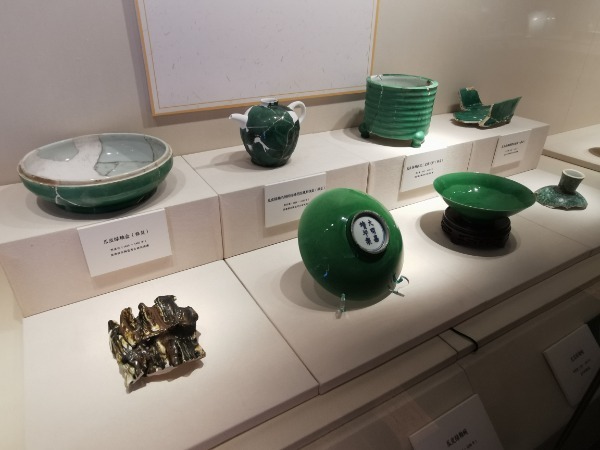
And Lyu also points out that the comparative display vividly shows the complex process involved in making porcelain fit for the emperor.
An exhibited meiping-literally meaning "plum vase" due to its common usage to hold plum branches for decoration-from the reign of Yongle, is a typical masterpiece of its time.
"It started a new trend favoring elegance, close to literati's taste," Lyu explains. "And it's exceptional because it even has a lid. It's rare to see a meiping with a lid, as these are easily broken."
Its delicacy becomes even more shining when part of a similar vase from the imperial kiln lies just beside it.
"Maybe the temperature was too high leading to the body collapsing," Lyu suggests.
Controlling the temperature of the kiln during a time without thermometers was tricky, as the exhibition shows. For example, to make the red glazed ceramics, a main variety among the products of the imperial kiln in the early 15th century, the temperature had to be maintained at between 1,250 to 1,280 degrees.
"Such a narrow span of temperature leaves little room for error," Lyu says. "Though the artisans were experienced, the odds against success were still high."
Various single-color porcelains were made during different reigns of Ming because each emperor had his own preference.
For example, yellow artifacts resembling the color of chicken soup, were favored by Emperor Hongzhi (1470-1505), while his son Emperor Zhengde (1491-1521) liked malachite green. Also a fan of green glaze, Emperor Jiajing (1507-67) took the initiative to introduce the color of "watermelon" to the surface of porcelain, while Emperor Wanli (1563-1620) preferred the color of eggplants.
It is hard to know just how many unfortunate buddies of the surviving porcelains were smashed into pieces, probably just because their colors were not quite right.
More than 1,400 artifacts have been pieced together from the fragments in Jingdezhen, and Jiang says that even the "broken pieces are still precious treasures". After all, although most of the artifacts from the Palace Museum and Jingdezhen match with each other, some patterns found in the kiln ruins have no known counterparts.
A blue four-footed oval tub from the reign of Xuande (1426-35), which was designed to grow narcissus is such an example.
"The study and categorization of the porcelain fragments found in Jingdezhen are still continuing," Jiang says. "Police authorities in Jingdezhen have also retrieved many porcelain pieces illegally dug up in recent years and these offer many new clues. Consequently, people will get a deeper understanding of the operation of the Ming imperial kiln in the future."





