


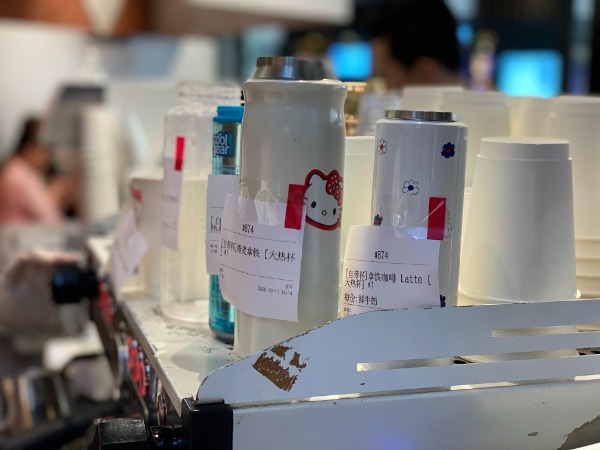
According to Zhang Ling, founder of Writer Coffee, nearly two-thirds of her customers bring their own cups.
"In the beginning, it was mostly foreign guests who brought their own cups because they're used to doing so. Later, more Chinese started to do the same as we have been promoting the discounts that they can enjoy if they do so," says Zhang.
Writer Coffee currently offers a 5 yuan discount to guests who consume their coffee using a mug from the cafe. It also loans cups to customers who prefer not to use the disposable option.
To date, one-fifth of Writer Coffee's customers choose to leave their cups in the store.
Zhu Yifan, 32, who works in an office located near Writer Coffee, leaves her cup in the store every day after work and picks it up in the morning before work. What motivated her to carry out this practice are the garbage-sorting measures and empty-plate movement, or anti-food-waste movement, that the government has been promoting in recent times.
According to a China Central Television survey last year, Starbucks uses 4 billion disposable cups that require 1.6 million trees to make each year. The survey also lists some fast-food chain enterprises, which sell a large number of cups of beverages.
While the survey points out that most consumers would dispose of these cups into the recyclable section of rubbish bins, a garbage-collection station in Beijing says that wet and dirty paper cups will not be recycled.
"In order to improve its anti-osmosis and strength, we paste a layer of plastic on the cups so that it became a composite paper product, and this interferes with paper recycling. The cost of separating the plastic from the paper cup is very high," Tsinghua University environment professor Liu Jianguo tells China Central Television.
"We can only try to avoid the use of such cups in the first place. If we have to use it, then we use it as many times as possible to prolong its service life."
Other countries around the world have also set their eyes on reducing the use of disposable paper cups and encourage people to use more environmentally options.
For example, Ireland's environment minister announced in November 2019 that consumers who use disposable cups will by 2021 be subjected to a "latte tax".
It was also reported that the United Kingdom uses 2.5 billion disposable paper cups a year, almost none of which are recycled. For this reason, British legislators have called for a tax on paper cups as they believe that manufacturers of these products should pay more.
The UK's House of Commons Environmental Audit Committee had also urged the government to set a goal of recycling all disposable cups by 2023, failing which an outright ban on such products should be put in place.





