


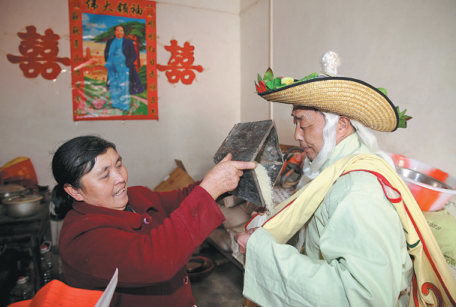
"Our performance is not limited by place or music," says Zhou. "The content of the lyrics is quite extensive and inherited by apprentices from generation to generation.
"We will sometimes ad-lib by what we see, and speak accordingly based on who we meet," he says, adding that the lyrics of what they sing often emerge on the spot.
The language is witty and humorous. The content of the singing closely keeps up with the times and the lyrics change to accommodate that, according to Zhou.
"Therefore, the rule I follow when accepting apprentices is to find those who are intelligent, quick to respond, educated and have strong speaking ability," says Zhou.
Historical records show that the activity originated in the Sui Dynasty (581-618) and thrived in the Tang Dynasty (618-907).
Legend has it that in ancient times, farmers didn't know the exact farming seasons, so they plowed and sowed at will. As a result, harvests were often bad, due to poor timing when sowing crops.
In the Sui and Tang dynasties, officials involved in formulating the astronomical calendar at the imperial court had calculated and worked out a more accurate time scale. Farmers near the ancient imperial capital followed the new calendar to grow crops and got bumper harvests.
It is said that the Tang emperor at that time was very glad to get the information. To make more people across the country aware of the new calendar, the emperor came up with the way of delivering messages to people from door to door. In a grand festival at the end of one year, the emperor assigned his prime minister, Wang Huai'en, and artists from the imperial palace, to spread the happiness to folks.
According to the emperor's will, Wang wrote lyrics involving good wishes and congratulations, as well as farming seasons and feudal ethical codes, which would be recounted by actors through storytelling to give people the guidance in an entertaining way. The astronomical calendars and seasons were also printed onto posters, named "Spring Posters", which would be given to remind farmers to cultivate on time.





