


It is obviously a positive word, but the rhyming duplication and cutesy suffix are abused in all most all circumstances. Loyal defenders of the Chinese language called for an official ban of "language degeneration", as they describe it.
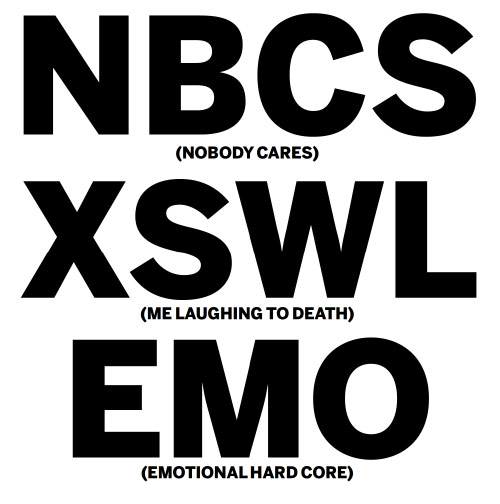
NBCS, an abbreviation of the English words, nobody cares, is interestingly an internet buzzword in China while in the English-language world it is not very prevalent. The post-00s generation is very prudent when using it by adding the "s" at the end.
XSWL, the abbreviation of xiao si wo le, "me laughing to death" literally, is also a popular acronym on the Chinese internet, equivalent to the English LOL(laugh out loud).
Some trendy slangs are rooted deeply in pop culture. The words "high-quality human" originated from Xu Qingen, a young man who posted on his Instagram a courtship video high-quality human male who not only speaks English well but is also very rich. He can meet the needs of women in all aspects by boasting his advantages. He hopes that those women who are interested can send private messages to him to discuss in details.
His unique nerdy and coquettish style turned in a delightfully camp performance with his greasy hair and big glasses. The heavy whitening foundation on his face, coupled with his overly formal vocabulary only added to his odd persona. Young people quickly pounced on Xu's overconfidence and started to use the phrase "high-quality human" to fling it sarcastically at those with outsized egos.
Even those born in the 1990s complain that they often do not understand the various memes and idioms of those born in the 2000s. These internet terms that puzzle them are the language system of the post-00s generation. For the elder age group, post-00s slang is language-turned-convict.
During last year's two sessions, several representatives put forward proposals such as "regulating online language" and "banning vulgar words", specifically to address this issue, expressing the need to reduce online language misuse and strengthen the protection of Chinese.
However, many experts and scholars in linguistics and communication including Feng Zhiwei, computational linguist, specializing in interdisciplinary research in linguistics and computer science, believe that internet language is a natural product of the dynamic development of language, and it is not necessary to deliberately prohibit it.
The post-80s generation despised the "Martian text" used by those of post-90s back then, a disobedience to grammatical and orthographical norms that results in Chinese characters being replaced with substandard ones or foreign scripts. It is a combination of simplified Chinese, traditional Chinese, uncommon characters, Japanese, symbols, phonetics, etc. People who do not know how to use it often need to use an online translator to understand it. For example, when typing the word "star" in Chinese, they prefer the unicode symbol that visually represents an actual star.
It was ridiculed as brain-disabled characters 10 years ago. But later, interestingly, the Martian text disappeared naturally and no one is using it nowadays.
Behind the evolution of language, it reflects the development of the times, and also reflects the current social and cultural life psychology. In this sense, it is not that this generation of young people do not speak "well", but in fact, each generation has a generational style of language, says novelist Ma Boyong, when addressing the phenomenon last year at an interview with The Paper News.





