


Family ties
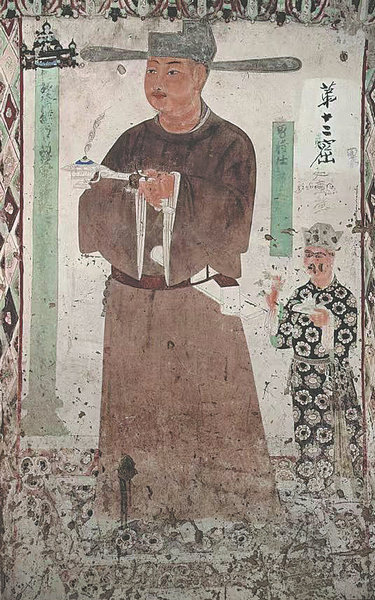
When Cao Yuanzhong, son of Cao Yijin who ruled Dunhuang between 944 and 974, appeared in a fresco in one of the Dunhuang caves, he chose to be seen in a hat and a robe that seems to have been directly borrowed from the royal wardrobe of a contemporary Northern Song emperor.
Both the Dunhuang governor and the Northern Song emperors accentuated their minimalist style with belts decorated with Khotan jade — luxury items on the Silk Road that worked their way into "a shared culture of kingly dress" to quote Wen.
The long journey of the jade — from Khotan to Dunhuang and, ultimately, to the Northern Song capital of Kaifeng in modernday Henan province — also belies the persistent effort of one particular ruler of Khotan — Visa Sambhava — to reconnect with the "heavenly empire", from which his territory had been cut off more than half century prior.
These included forging closer ties with Dunhuang by marrying the daughter of Cao Yijin and, rather extraordinarily, adopting for himself and his successors the surname of the Tang royal family, Li. Visa Sambhava, or Li Shengtian as he chose to be known, declared himself "a Tang imperial descendant", a claim substantiated by the marriages between Tang princesses and his royal ancestors, one of whom, in the eighth century, famously chose to settle in the Tang capital of Chang'an after arriving there with his Khotan soldiers to help put down a revolt that lasted for eight years.
"While commoners depended on the road for material necessity, the kings and officials relied on it for legitimacy," says Wen. That explains why Zhang Chengfeng, whose war with Ganzhou wrecked "the eastern road", was blamed by his own people. If peace was sought and obtained in the name of the road — the Ganzhou ruler withdrew his army upon receiving the letter of petition — war was fought in its name, too. According to Rong, somewhere between late 924 and early 925, barely 13 years after Dunhuang's defeat, Cao Yijin, whose rise to power was propelled by that defeat, initiated another military campaign against Ganzhou.
The reason for taking such apparent political risk was cited in a popular song believed to have been performed during New Year celebrations in Dunhuang. "For several years, the road to the east was obstructed/rendering us fish in a small pond," the song goes. In other words, Ganzhou, situated to the east of Dunhuang, had blocked the way to northern China and severed the city from the road that meant oceans for them.
This time, likely with huge popular support, Dunhuang prevailed over Ganzhou. "Envoys from the inner land (northern China) newly descend upon our western garrison/and the Son of Heaven congratulates our righteous army," continues the same song, which opens with the sentence "Hexi is the old land of the Han family" — the Hexi Corridor being part of today's western China to which Dunhuang and Ganzhou both belonged.
According to Wen, one of the largest known groups of travelers ever recorded on the Silk Road was a delegation from Khotan to the empire of Han (206 BC-AD 220), and included 1,074 members. Taking the region under its wing and installing a tributary system with itself at the center, the Han Dynasty saw its symbolic power and binding force invoked in times of contention, seven centuries after it had ceased to exist.
It was the same with the Tang, says Rong. "For the populace in both northern China and the Hexi area, the empire's rallying force persisted long after its collapse. Those who recognized it, the Khotan ruler Li Shengtian for example, actively sought alignment with whatever power seemed to have emerged out of the shadow of the Tang. He was among the first rulers along the Silk Road to congratulate the founder of the Northern Song Dynasty and pledge his allegiance."





