


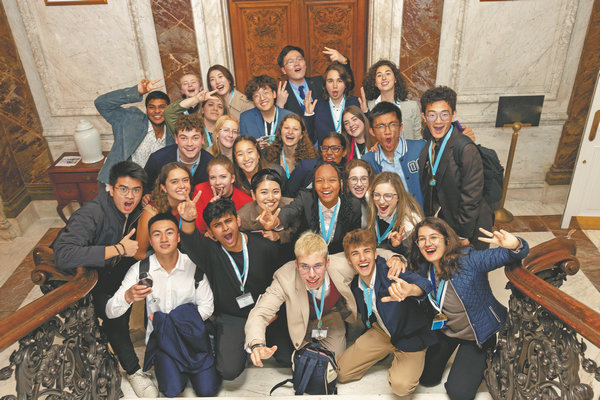
You don't get a second chance to make a first impression — this was the theme of this year's International Public Speaking Competition (IPSC), held in London from May 11 to 12. Thirty-three young speakers aged 16 to 20 from around the world gathered at The English Speaking Union to tell their stories, including Wu Dongxu from China. To him, the event wasn't just about giving a speech on first impressions. It also made a strong impression on him.
"Rather than a competition, the experience was more like an enlightening research trip to me, a trip that allowed me to see firsthand the differences and similarities between Chinese and foreign cultures," said Wu, 19, a student at Hangzhou Foreign Languages School, Zhejiang province.
Apart from the obvious differences in food, transportation and climate, what impressed Wu the most was the distinct styles of Chinese and foreign public speaking.
Although still a teen, Wu is no stranger to the public speaking podium — having participated in domestic competitions regularly since 2017. But on the stage of the IPSC, speakers had no podium to stand behind. They just had to face the audience.
"This was the first time that I gave a speech without a podium, which made me realize how important eye contact and body language are," said Wu. He found it quite freeing, in fact, as you're not left stranded by the podium. Speakers have the freedom to convey more information with their gestures instead of just with what they say.
Another difference that caught Wu's attention was the evaluation criteria. According to him, in every single speaking competition he had participated in in China, things like pronunciation, intonation, flow and quality of language have always been a component of — if not a crucial part of — the evaluation criteria. But to his surprise, the IPSC organizing committee informed all the contestants before the event that accents and grammatical errors would not be considered in the evaluation process, meaning that delivery and your conveyed story are what matter most.
"Audiences are eager to hear powerful stories, especially those that still resonate with people regardless of where they are from," said Wu.
He gave some examples: a Mexican contestant who told of how she managed to change people's stereotypes toward Mexico, a Sri Lankan girl who proudly introduced the customs of her country and the traditional wooden handicrafts that she brought on stage, as well as a Japanese girl who told how she, triggered by an incident at school, began to reflect on the Nanjing Massacre.
"These are the emotions shared by all human beings. We share these similarities despite our differences," said Wu. "Diversity, respect, tolerance and understanding — these are what the IPSC organizing committee, and what all the contestants including me, are hoping to see in international events like this."
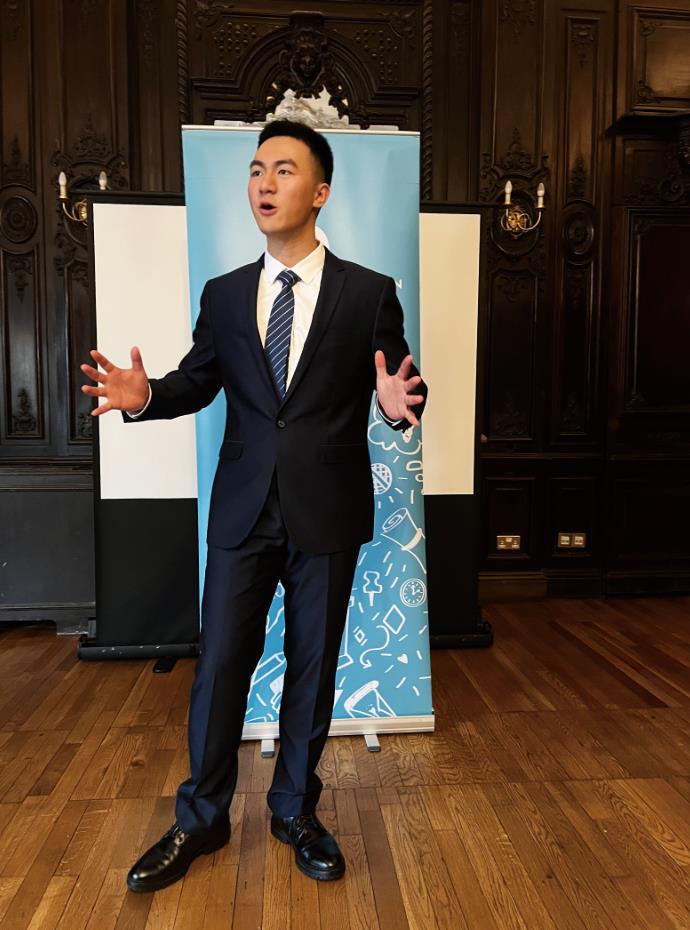
An extract of Wu's speech
"Last year, I had the great opportunity to attend a lecture by a retired United Nations translator, and his words conveyed that in the international arena, "the first impressions" created by translators may also exert a vital influence on major-country negotiations.
For instance, in 2015, Cuba and the US historically resumed diplomatic relations after more than 50 years of tension, and the translation of the announcement was very accurate and clear, helping usher in a new era of relations between the two countries. In 1972, Premier Zhou Enlai met then-US President Richard Nixon in China, and as the interpreters translated articulately, the two leaders' fruitful talk laid the essential foundation for re-establishing our diplomatic relations. In his lecture, the UN translator also talked about the same thing in his work for the United Nations, where differences and disputes prevail, and languages and cultures collide.
It is UN translators who ensure the extreme linguistic accuracy of assorted documents, and these interpreters who concentrate all their attention on conveying information simultaneously to all representatives. Across linguistic and cultural barriers, they create the first impressions for different countries that can make or break international relations, and they are given no second chance."





