


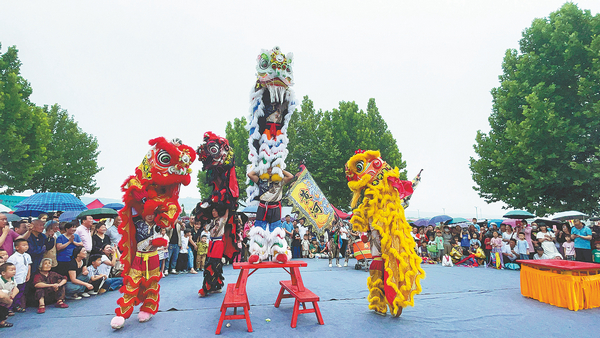
"They must be capable of imitating the lion's suspicion, joy, anger and other traits with lifelike accuracy," Yang says.
Those in the tail have to be strong, since they often have to lift people at the head which, if not done properly, can make the performance appear rigid and sluggish, he explains.
"The tail controls the overall range of motion of the lion dance," Yang says.
There is an ancient tradition in China of dancers wearing masks to resemble animals or mythical beasts.
A popular legend about the origin of the lion dance suggests that, before the Han Dynasty (206 BC-AD 220), due to the Silk Road, a few lions had reached the Central Plains from the western area of ancient China.
At that time, people mimicked the appearance and actions of the newly arrived lions in a performance that later evolved into the lion dance, which became popular during the Tang Dynasty (618-907).
After that, the lion dance became synonymous with traditional, cultural and religious festivals, such as Chinese Lunar New Year. It has also spread abroad, as overseas Chinese established lion dance clubs to celebrate their traditional events in foreign lands.
To date, the lion show is divided into southern and northern schools. The northern lion's appearance mostly resembles a real creature, with a lion head. The southern takes inspiration from opera facial styles, featuring vibrant colors and meticulous craftsmanship.
The Xitao lion dance falls into the northern category. It was founded during the Qing Dynasty (1644-1911) by Yang's family, whose ancestors were martial arts experts.
They developed their own lion dance troupes and integrated their martial arts movements into the dance, which evolved to have its own characteristics.
In the 1990s, Yang's grandfather set up a martial arts school in the town, and students were selected to perform lion dances during major celebrations.
It exposed Yang to the distinctive dance at an early age.
"When I saw the lion dancers galloping on the high piles, I was itching to try it myself," Yang recalls.
In 2001, his grandfather led a team of more than 20 students to engage in a martial arts exchange in Guangdong province, where he saw the southern-style lion dance, which was more standardized and, he felt, had a certain panache.
It prompted him to look into it, so he sent eight trainees, including Yang, to one of the biggest lion dance schools in Guangdong in 2003.
Yang says it was a bittersweet experience.
"It was hard to be away from home for my age, and the training was really difficult," Yang recalls.
They spent two to three hours practicing the dance skills while giving martial arts performances at local scenic spots to cover their living costs.
"We would deliver up to four martial arts shows every day, each for 40 to 50 minutes, and then continue practicing the lion dance when we returned to our accommodation," he says.





