


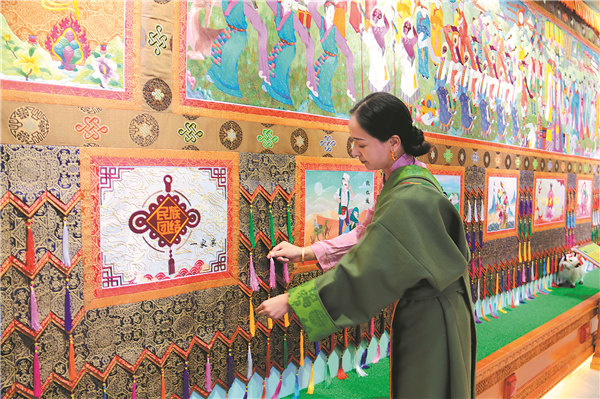
Lhamo Yudron was born into a family of embroiderers, and from a young age, she was exposed to Tibetan artistic techniques simply by being around her elders.
"Almost all Tibetan women know how to embroider, and the tradition is mainly passed down within families," she says. "In the past, Tibetan embroidery only appeared on the clothes and braided hairbands worn by women."
Her childhood pursuit turned into a passion after she saw embroidery from across the country at the Sichuan Museum in Chengdu, the provincial capital of Sichuan province.
"It blew my mind and led me to realize that embroidery can be really exquisite," she says, adding that the experience inspired her to carry on the heritage of Tibetan embroidery in her hometown on the Qinghai-Tibet Plateau.
In 2006, Lhamo Yudron started working at a Tibetan embroidery company her father had founded, and began to research ways of innovating traditional techniques to appeal to more people outside the plateau.
"Good Tibetan embroidery should not only meet the aesthetic preferences of modern people, but also integrate our traditional skills and ethnic culture in a way that delivers better expression," she says.
However, she found that most local crafts were passed down by the older generation. Driven by an ambition to carve out a new path for the art, she woke up at 4 am every day to study embroidery theory, and spent a great deal of time digging into books at libraries. With the help of the local government and senior embroiderers, she participated in training and cultural exchange activities and in the process, her mindset gradually opened up.
"After learning about sewing techniques and color matching elsewhere, I increasingly understood what the outside world wants," she says.
She came to better appreciate the characteristics of Tibetan embroidery and techniques after looking into the four famous Chinese embroidery styles, namely Su embroidery (with su as abbreviation for Jiangsu province, and Suzhou specifically), Xiang embroidery (Hunan province), Yue embroidery (Guangdong province), and Shu embroidery (Sichuan province).
"To put it simply, we needed to add some dimension to it, and vivid colors, and to highlight the layered stitching," she says. "When innovating, we must follow our own feelings and tell our own cultural stories."
In 2009, Lhamo Yudron set up an embroidery company in her hometown and transferred the patterns from Tibetan costumes onto canvas, showcasing natural landscapes and wildlife through the art, enriching its forms of expression.
At the beginning, she struggled to portray her subjects in a vivid manner. "When I wanted to embroider a Tibetan antelope, for example, it was difficult to depict with the silk threads traditionally used in Tibetan embroidery, as they had too few colors and were not fine enough," she says.





