


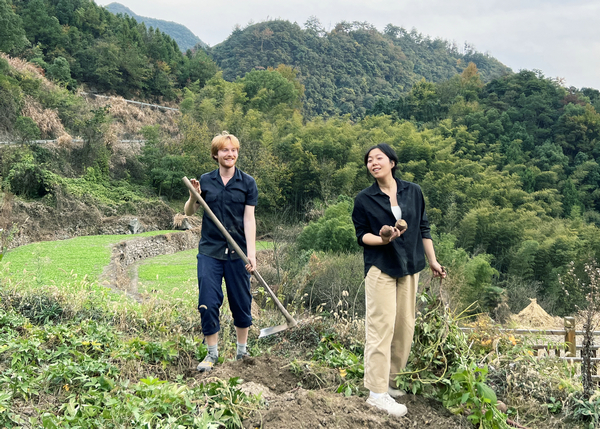
Last autumn and again this spring, I went to visit a small locale, Xuling village, in the hills of Zhejiang province. While I was staying there, I got to meet some members of a new community that had settled among the abandoned houses in the old village — where, they had started an "eco-village".
The members of the eco-village that I got to talk to had all come to this place for their own personal reasons, but they shared many core beliefs: they all found the lives in the cities to be too stressful, too harsh, and too suffocating. They had come to the eco-village to try a different way of living that they hoped would suit them more and fulfill them in other ways.
The eco-village offers a two-year program, where you pay an initial deposit; and if you complete the program, you get your payment returned.
During their stay in the village, the residents live communally, sharing living spaces and the duties of cooking, cleaning, and farming. All the farming is, of course, organic. The members are also expected to study ecology and spirituality and to practice meditation.
When I had the opportunity to visit one of their study rooms, I found the contents of their bookshelves to be quite fascinating. On the one side, they had ecological magazines and books on the topics of climate change, green technology, and sustainability, and on the other side, they had the classical Chinese texts of Confucius, Lao Tzu, and Chuang Tzu in addition to various Buddhist writings, both classical and modern.
I found this combination to be very insightful into their way of thinking in the eco-village. Not only do they want to learn about and practice living sustainably by producing their own food, living closer to nature, and minimizing their CO2 footprint, but they also seek to study and practice meditation and spirituality.
However, the eco-village didn't work for everyone: many left before they finished the two-year program, perhaps because the drastic lifestyle change was too much for them, or that communal living left too little room for individuality and personal space, or perhaps they just did not enjoy the rural life.
But it certainly worked for some. One woman told me of the stress and pressure she had felt from home since she did not conform to a traditional female role. However, by coming here and learning about and practicing meditation, she learned to overcome this stress and found peace and quiet.
Countryside dreams
The idea of escaping cities and retreating to villages is a big topic in China nowadays, and this is not only based on my own anecdotal experience but can be seen statistically as well. Eight eco-villages have been established in various provinces in China just this past decade, with the largest boasting 3,200 members.
The idea of fleeing the stressful life of the urban centers in favor of a down-to-earth, simpler life in the countryside is nothing new in China. The Story of the Peach Blossom Spring is a famous narrative poem written by the poet, bureaucrat-turned-recluse, Tao Yuanming, in 421 AD. It describes a veiled world of wonder, inhabited by people who live in a rural paradise and who know nothing of the outside world. The story encapsulates some ideals of what a good life is — something universally sought among humans.
Thus, this notion that paradise is not to be found in the cities but somewhere in the countryside is an ancient idea in China that is still very much alive in 2024, as it was in 421 AD.
Written by August Hagen, a 22-year-old Norwegian who is passionate about learning Chinese language and culture. He is currently studying for a master's degree in Chinese language and culture at Fudan University in Shanghai.





