



Guidelines set out path to green future
Non-fossil energy to account for a quarter of total consumption by 2030









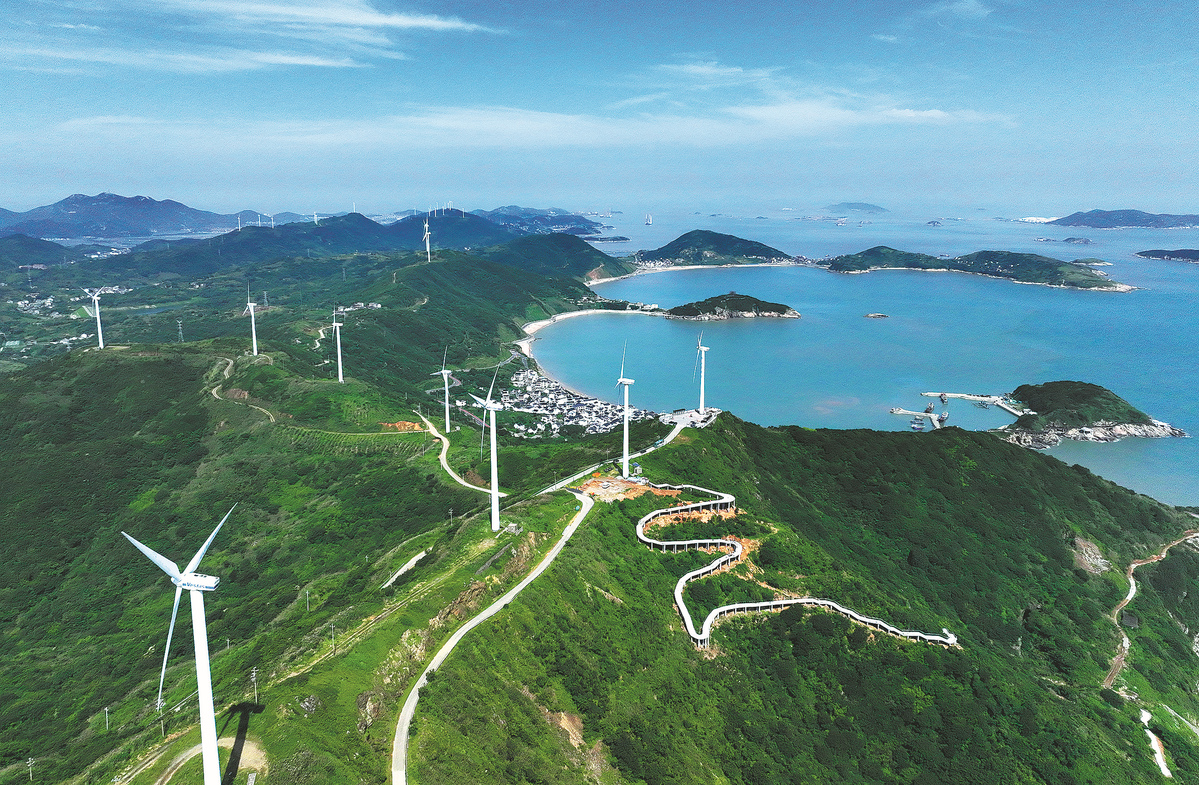
The Communist Party of China Central Committee and the State Council have released guidelines aimed at accelerating green transition in the country's socioeconomic development.
The guidelines set ambitious goals, including achieving "remarkable results" in green transition by 2030 and establishing a green, low-carbon and circular economic system by 2035 as part of efforts to achieve the vision of a "Beautiful China".
They outline a series of tasks, such as optimizing land use, promoting green and low-carbon industrial and energy transitions, and advancing sustainable urban-rural development. Specific targets include expanding the value of the energy conservation and environmental protection industry to 15 trillion yuan ($2.1 trillion) and increasing the share of non-fossil energy to 25 percent of total energy consumption by 2030.
Additional goals include reducing the carbon emissions intensity of commercial transport by 9.5 percent and boosting the annual utilization of bulk solid waste to 4.5 billion metric tons by 2030.
The National Development and Reform Commission said the guidelines were issued following significant progress in green and low-carbon development since the 18th CPC National Congress in 2012.
By June this year, renewable energy accounted for 53.8 percent of China's total installed electricity generation capacity. Energy consumption per unit of GDP was down more than 26 percent from the level in 2012, and carbon emissions intensity per unit of GDP was down more than 35 percent.
However, the NDRC acknowledged ongoing challenges, such as the nation's continued reliance on coal and the high proportion of fossil fuels in the energy mix. The global green transition also faces setbacks, with environmental and climate issues becoming increasingly politicized, and green trade barriers escalating.
China will also pursue supportive fiscal and taxation policies to promote green and low-carbon development and develop financial instruments such as green equity financing and green financial leasing.
Experts highlighted the importance of a comprehensive approach to green transition, focusing on both supply and demand. Lin Boqiang, director of the China Institute for Studies in Energy Policy at Xiamen University, emphasized the need to address the rapid growth in energy demand alongside the expansion of renewable energy production.
"While new energy is growing rapidly, fossil fuel use is also increasing," Lin said. "To accelerate the green transformation, more effort is needed on the demand side."
Zhang Jianhua, director of the National Energy Administration, told a news conference in June that China's energy supply has grown by nearly 20 percent since the start of the 14th Five-Year Plan (2021-2025).With ongoing industrialization and urbanization, energy demand is expected to continue rising.
Lin said: "The growth in energy demand is closely related to industrial development and people's lifestyles. Increasing energy prices is one of the most effective ways to mitigate the growth in energy demand, and it might be worth trying.
"For example, the electricity price in China is much lower than its actual cost in China with government subsidies. In the development process of the past few decades, we needed to first ensure that people had access to electricity. However, with economic development, the price of electricity can also be considered for adjustment.
"An increase in energy prices may have a restraining effect on industrial development. What we need to do is to generate more GDP with less energy."
Lin said that China's energy policy is formulated based on specific national conditions.
"Income levels, development stages and industrial chains vary among different countries, so there is no comparability in terms of energy policies," Lin said.
"China still has significant room for improvement in energy conservation and emission reduction and should adjust its industrial structure according to actual circumstances."


- International Policing Forum focuses on the rise of cybercrimes
- China, Mongolia launch joint army training
- Scenic Dushanzi-Kuqa Highway to open on Monday
- Three workers die following construction accident despite rescue efforts
- International students witness rural vitalization in Ningxia village
- China's space station lands new batch of samples for experiments





