


Royal resting places
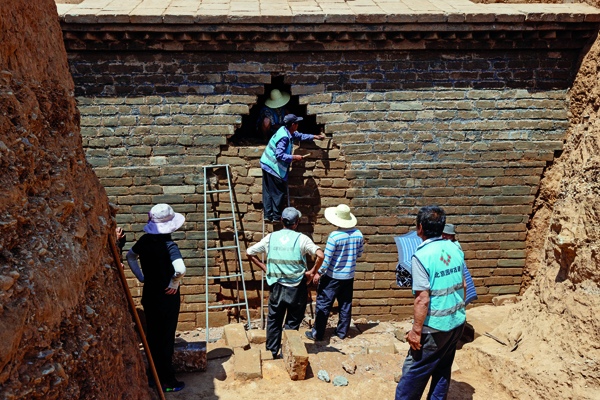
The latest discoveries have also shed light on another World Heritage Site: the imperial tombs of the Ming and Qing dynasties. Beijing has long been known for the tombs of 13 Ming emperors and their families in Changping district, but in 2022, archaeologists discovered a new imperial graveyard at the foot of Xiangshan Mountain, and began excavating.
Zhang Lifang, an associate researcher at the Beijing Institute of Archaeology, says the graveyard is ringed on three sides by mountains, and has three south-facing cemetery complexes ranged from east to west.
"The three complexes have clear layouts and intact structures of tombs and memorial halls," Zhang says.
Based on epitaphs found on the site, and the layout of the tombs, archaeologists believe the eastern complex was for imperial children who died young, among them, Princess Yunmeng, one of Emperor Wanli's daughters. Lying beside her is a tomb inferred to belong to her sibling Zhu Changxu, who died soon after birth and whose mother was Emperor Wanli's beloved concubine.
Zhang says the layout of this complex is very similar to the tomb of Emperor Wanli, which has been excavated and is open to the public.
The middle complex belonged to Emperor Jiajing's concubine, surnamed Wang, and the western complex possibly contained the tombs of several concubines buried together.
Archaeologists also found sacrificial vessels, stone tables, thrones, bottles and wooden figurines in the tombs.
"This is the largest imperial tomb group we have excavated since the Ming tombs in Changping. Although some have been destroyed or looted, their remaining layout, size and artifacts demonstrate their scale and strict building methods," Guo says.
"This provides a direct reference for understanding imperial burial customs, rites and the engineering of the dynasty."
Other discoveries released include the analysis of female bones found in a well at the Luxian Gucheng Site in Tongzhou district, identified as the location of Luxian county during the Western Han Dynasty (206 BC-AD 24), which revealed how they died, and the possible reasons for their deaths, as well as an imperial stone road dating back to the Qing Dynasty in Fengtai district.
"We have uncovered many of the human stories behind the heritage," Guo says. "Through archaeological discoveries we can make guesses about life and death in ancient times, as well as the experience of those who lived then to develop a better picture of society at the time."





