


The brutality left 13 villagers dead, 11 permanently disabled, 11 taken captive, and more than 700 homes reduced to ashes.
That massacre ignited locals' resolve to resist.
"At first, people just dug holes in the ground, so that there would be a place to hide if the enemy came," says 98-year-old Li Hengbiao, the last surviving tunnel fighter.
As Li recalls, records show that initially the dugouts only had a single entrance and gradually evolved into an engineering marvel — with multiple entrances and a mazelike structure that outwitted the enemy.
According to the Ranzhuang Tunnel Warfare Memorial Hall, the Ranzhuang tunnel is generally 0.7 to 0.8 meters wide, with a height of approximately 1 to 1.5 meters, and is located more than 2 meters below the surface.
The tunnels were carefully divided into military tunnels for combat and civilian ones for concealment. Inside were command posts, storerooms, rest chambers, road signs, oil lamps, and even secret arsenals.
The villagers' ingenuity turned defense into artful strategy. When Japanese forces flooded the tunnels, builders carved dual-layer channels to divert water into wells. When faced with poisonous gas, they devised fanyan, or "flip-eye" facilities, that sealed off contaminated sections while venting fumes.
Mines were wired with fuses leading back into the tunnels, enabling fighters to trigger explosions beneath invading soldiers' feet.
With these clever design and strategic layouts, the people of Ranzhuang, under the leadership of the Communist Party of China, utilized the tunnels to coordinate with Chinese armies in 157 engagements, causing more than 2,100 enemy casualties, according to historical records.
In 1945, Ranzhuang was honored with the title of "Model Village of Tunnel Warfare".
"This is what fascinated me most — the underground armory," Bohan says, while crouching in a cramped chamber.
"Here, in the dark and cramped space, the militiamen of that time forged numerous weapons," she says, adding that without this underground workshop, they couldn't have fought or won.
"The history of Ranzhuang serves as a source of inspiration for us to continue striving in the new era, safeguarding peace and development," she says.
Today, the site preserves that determination. Covering 200,000 square meters, it includes more than 200 traditional residences, fortifications and historical buildings. Around 3,000 meters of tunnels remain intact and accessible.
Each year, the site receives over a million visitors.
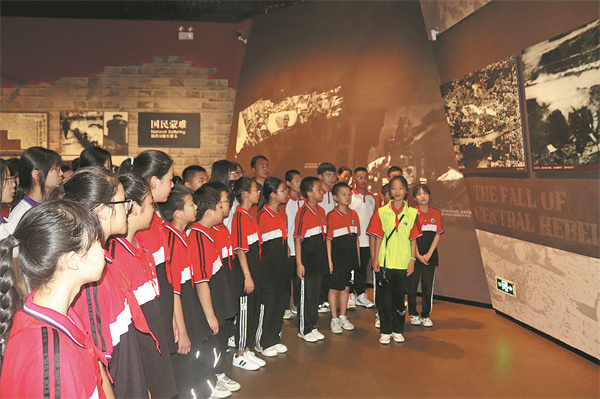
Since last year, 683 organized groups — students from elementary schools to universities — have visited for research and study tours. More than 26,000 people have been directly educated at the site, carrying forward what locals call the "red culture" of resilience.
Sun Ke and Zhao Rixi contributed to this story.





