


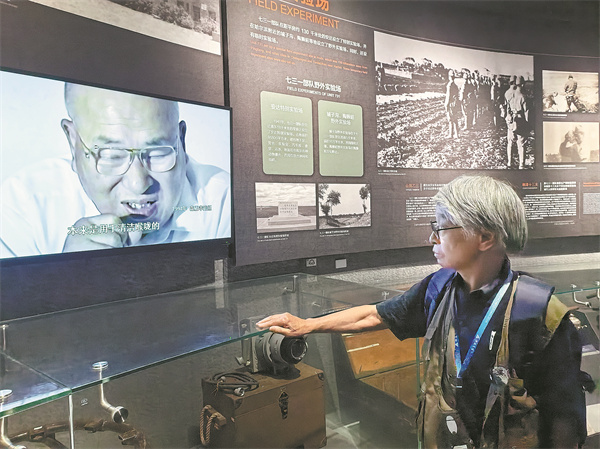
For Masataka Mori, a former professor of irenology, the study of lasting peace, at Shizuoka University, the ruins of Unit 731 — a germ warfare unit that was clandestinely operated by the Japanese invading army during World War II — are not just a historical attraction, but a testament to atrocities that must never be forgotten.
On Aug 20, the expert, who spent over 40 years researching the notorious Unit 731 and Japan's germ warfare against other countries, led a 20-member delegation to the crime evidence exhibition hall of this infamous biological warfare unit in Harbin, Heilongjiang province.
The delegation, consisting of retired history teachers, documentary directors, agricultural workers, and anti-war activists, traveled from Japan with a shared mission to witness history firsthand and amplify calls for peace back home.
Inside the hall, detailed archives, authentic footage, and material evidence laid bare the crimes against humanity committed by Japanese militarism. The exhibits revealed the structure of Japan's biological warfare units and the horrifying fate of countless marutas, a dehumanizing code name for live experiment victims. Each display stood as a silent witness to these heinous crimes.
At least 3,000 people were killed by human experiments conducted by Unit 731. Japan's biological weapons killed more than 300,000 people in China.
"The lies written in ink can never cover up the facts written in blood," Mori quotes renowned Chinese writer Lu Xun while explaining the displays to the delegation. The crimes of Unit 731 extended beyond ghastly human experimentation to include widespread biological attacks across China.
Mori's connection to the exhibition hall dates back to its founding in 1985. His work has been dedicated to ensuring that Japanese society confronts this dark chapter of history.
"I filmed this," he says. Mori filmed many video testimonies with former unit members, including one from Sadao Koshi, a former driver employed at Unit 731 who transported victims. These recordings serve as invaluable historical evidence.
The group then proceeded to the former site of Unit 731's headquarters, the nerve center of Japan's biological warfare operations. The once heavily guarded building still stands, while behind it lie the remnants of the square-shaped experimental complex.
Jin Chengmin, curator of the Exhibition Hall of Evidences of Crime Committed by Unit 731 of the Japanese Imperial Army, emphasized that preserving the site is a core mission to help future generations confront history. On its 40th anniversary, the institution prepared an application for UNESCO World Cultural Heritage status for the site, seeking continued global recognition and support.
During a subsequent symposium, Mori reflected on his four-decade-long struggle. As a history teacher, he was once dismissed for teaching the truth about Japan's war of aggression. Undeterred, he traveled across China to interview survivors and, at great personal risk, persuaded aging Japanese veterans to confess their atrocities on camera.
He received death threats, including envelopes containing razor blades, menacing phone calls, and being followed.
Members of the delegation also shared their connections with the exhibition hall and the city of Harbin.
Masaru Nakano, a former math teacher at Hiroshima Gakuin Junior and Senior High School, worked as a guest researcher at the Harbin Academy of Social Sciences in 2003. He translated several Chinese books into Japanese, providing a critical window into Unit 731 for Japanese readers.
Another member, Akiyoshi Takanashi, a former city councilor from Yokohama who visited the facility a decade ago, was struck by the exhibition hall's technological advancements and new exhibits. Having worked for years on exhibitions related to wartime atrocities, he hopes to share the latest historical evidence and facts with a broader audience.
The delegation signifies a persistent anti-war and pro-peace force within Japanese civil society, says Yang Yanjun, a researcher at the Research Institute of War Crimes Trials and World Peace at Shanghai Jiao Tong University.
At a memorial wall in a corridor on the first floor of the former headquarters, bearing 3,000 black stone plaques commemorating those who perished in Unit 731's experiments and biological attacks, the group offered flowers as tribute.
Following the visit, Mori urges more Japanese to visit China, hear the victims' stories, see the historical evidence, and confront the brutality of Japan's past aggression to ensure an accurate understanding of history and prevent its repetition.
The Japanese government's most crucial task is to acknowledge historical facts and explicitly include the truth about its aggression in school textbooks, he says. "Failing this, young people cannot learn this history through formal education, and its absence will lead to the tragedy repeating itself."





