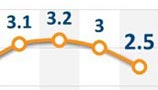
Editor's note: The nation's economic growth slowed in the third quarter to its weakest pace in five and a half years. But markets were prepared for that result and reacted calmly. We asked domestic and foreign economists for their views and found a surprising degree of convergence: growth next year is set to slow. They also agreed that lower growth is not in itself a problem, as long as enough jobs are created, incomes keep rising and the government continues to pursue structural reforms. Here are their comments.
Q1 Given the third-quarter figures, do you think the Chinese economy can grow by 7.5 percent this year? If yes, why? If not, is it a big problem?
Q2 Should China lower its GDP growth target next year? What is the appropriate rate?
Q3 There is no doubt that China is slowing. Will the slowdown do more good than harm to the country in the long run? Why?
Q4 What are the benefits and drawbacks of China's slowdown? How can China reduce or avoid damage?
A1: The bad news about the third-quarter figures is that they suggest the lowest level of growth since the onset of the global financial crisis half a decade ago. The good news is that they indicate a pickup in momentum. The government's target for 2014 has been "about 7.5 percent". With a stronger fourth quarter, that is still possible. What matters for future growth is that the reform momentum broadens and deepens.
|
 |
|
Dan Steinbock, head of international business at the US-based India, China and America institute |
A2: Skeptics would probably argue that a realistic rate is about 6 to 6.5 percent, whereas bulls favor a range of 7 to 7.3 percent. The appropriate number is one that sustains adequate growth potential, which supports social stability. That, in turn, is based on stable employment.
If policymakers presume that 1 percentage point of GDP growth creates 1.5 million jobs per year and that about 10 million jobs are required, the minimum GDP growth rate should be about 6.7 percent. If you include a safety cushion, the final figure is about 7 percent.
A3: The third-quarter figures suggest that the slowdown in real estate was huge relative to the past year, while foreign demand provided a cushion against greater deceleration.
Domestically, policymakers are coping with excessive local debt that was created in the aftermath of the global financial crisis. If deleveraging moves ahead too aggressively, housing sales will suffer.
Conversely, if deleveraging is too slow, it will boost the housing market and give rise to new bubbles. In this precarious balancing act, policymakers have opted for stability as opposed to bubbles.
A4: What matters is that employment remains steady, even as inflation remains relatively low. The goal for 2014 was to create 10 million urban jobs. That was exceeded in the first three quarters, when some 10.9 million jobs were created. That is how China has reduced the damage. The challenge is to sustain similar growth in 2015.
In most nations, the completion of industrialization and urbanization has meant decelerating growth but rising living standards.
That is why the reform agenda is so vital to the country's future. And that is why slowing growth can go hand-in-hand with rising prosperity levels.

Copyright 1995 - . All rights reserved. The content (including but not limited to text, photo, multimedia information, etc) published in this site belongs to China Daily Information Co (CDIC). Without written authorization from CDIC, such content shall not be republished or used in any form. Note: Browsers with 1024*768 or higher resolution are suggested for this site.
License for publishing multimedia online 0108263 Registration Number: 20100000002731