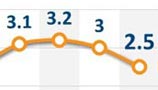
Fruit and vegetables together have the third-largest weighting in the basket and their price volatility ranks second after pork.
Consequently, this category is the second-largest contributor to movements in the food CPI. Examples of periods in which fruit and vegetable price volatility had a large impact on the food CPI include August 2005 to September 2006 and February 2009 to April 2010, times when pork price movements were negative.
Pork's contribution to the food CPI is obvious given the correlated trend movements. Being one out of thousands of products within the CPI basket, pork is estimated to have a relatively high weighting of 3.6 percent in the China CPI.
Moreover, it is not uncommon to observe pork price movements of more than 40 percent compared with the previous year. Along with its severe price volatility, its impact is astonishing.
More people have started to see the connections between changes in pork prices and the CPI. Hence, reporters argue that pork has "kidnapped" the CPI due to its large weighting compared with other products and its high price volatility.
Rabobank admits that it is fair to state that the CPI in China could confusingly stand for the "China pork price" as the pork price accounted for an overwhelming share of CPI inflation over the past decade.
However, that could be an over-generalization. Even though the pork price generally has the largest contribution to the CPI, it does not explain the entire picture.
Given the model that Rabobank proposes, the leading driver of the CPI is a product with extreme volatility despite its weighting. Although pork price volatility has a major bearing on China's CPI volatility, it is reasonable that any product could take the lead whenever its volatility outweighs the other products in the basket.
One good example would be in 2006 and 2009, when fruit and vegetable prices took over from pork prices as the key driver of the CPI. Fruit and vegetable prices were able to lift the CPI even though meat prices were moving lower.
Hog inventories reached a record high of 469.2 million head in October 2009, causing oversupply in the market. The corn-to-hog price ratio fell below 6.0, which indicated many pig farmers were earning less or even losing money.
Instead of waiting for the next pork price cycle, many farmers exited the market and slaughtered massive numbers of hogs and sows.
The total hog and sow inventory fell 7.2 percent from to 481 million head between December 2010 and May 2011, which laid the foundation for another pork price inflation cycle in 2011. In addition, pork supply was further limited due to the outbreak of foot-and-mouth disease, which caused pork prices to rise 49 percent, contributing to 1.8 percent of the CPI increase.
Why are pork and fruit and vegetable prices so volatile?
First, it is fair to acknowledge that historically China has been reasonably successful in reducing commodity price volatility. While global grain commodity markets encountered a boom and bust in 2008-09, China's wheat and corn prices remained relatively stable.
Although food price volatility is driven by a diversified basket of food items, meat and fruit and vegetables have largely contributed to the food CPI.

Copyright 1995 - . All rights reserved. The content (including but not limited to text, photo, multimedia information, etc) published in this site belongs to China Daily Information Co (CDIC). Without written authorization from CDIC, such content shall not be republished or used in any form. Note: Browsers with 1024*768 or higher resolution are suggested for this site.
License for publishing multimedia online 0108263 Registration Number: 130349