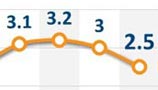
China's pork price volatility is mainly caused by the mismatch between supply and demand. Pork demand has low price elasticity due to Chinese traditional consumption habits.
The Chinese prefer pork to other meats, and pork accounts for more than 63 percent of their meat expenditures. In general, there is low elasticity for consumers to shift meat consumption to other proteins such as poultry, beef or sheep.
Despite chronic soaring prices, pork remains the staple meat for Chinese consumers. Only under extreme conditions have we seen consumers ration demand for pork and/or substitute with poultry.
Therefore, pork price volatility is more driven by supply fluctuation rather than changes from the demand side.
China's pork sector still faces many challenges, despite its remarkable transformation along the value chain.
Although so-called backyard farmers represented 20 percent of China's pork production in 2011, down sharply from 34 percent in 2010, the production base is still highly fragmented.
The sector is at the mercy of high supply inconsistency, mainly due to diseases and low replenishment. Such unpredictable and disrupted supply means amplified price volatility.
In a similar way, fruit and vegetables suffer the same supply constraints. China's pork and vegetable supplies both account for about half of the world's production, although the industries are among the most fragmented in the world.
The lack of economies of scale in both sectors exposes small farmers to significant downside risks. Given the roller-coaster profit levels, many farmers go into the business in the hope of selling their production during periods of rising prices and do not invest or even exit the business when the market outlook is pessimistic.
But those who stay in pig farming all the time can still adjust the replenishment of piglets according to their price outlook. Such behavior has left the supply outlook quite unpredictable, resulting in volatile prices.
Additionally, the pork and fruit and vegetable supply chains still have numerous intermediaries who tend to speculate on price, amplifying price volatility.
Also, pork and vegetables are not homogeneous: Both have product differentiations (such as frozen pork versus fresh pork or carrots versus broccoli).
As pork and vegetable items are highly perishable, moving supply from one place to another in response to shortages is still an issue due to cold supply chain limitations and cost issues. Thus, a series of mismatches between supply and demand translate into volatility in price.
Therefore, we can assume that China's problem of curbing food CPI volatility could be partly solved by an improved mechanism for managing pork price volatility.
Looking ahead, Rabobank believes pork will remain the key contributor to volatility in the CPI. Being able to predict pork price fluctuations could give clarity to the CPI outlook.
Contact the writers at jeanyves.chow@rabobank.com, ivan.choi@rabobank.com, and chenjun.pan@rabobank.com

Copyright 1995 - . All rights reserved. The content (including but not limited to text, photo, multimedia information, etc) published in this site belongs to China Daily Information Co (CDIC). Without written authorization from CDIC, such content shall not be republished or used in any form. Note: Browsers with 1024*768 or higher resolution are suggested for this site.
License for publishing multimedia online 0108263 Registration Number: 130349