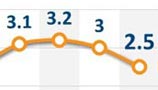
LONDON - China's demand growth for oil will slow down around 2030, although it will overtake the United States as the largest oil consumer by that time, said International Energy Agency (IEA) Wednesday.
IEA released its flagship World Energy Outlook 2014 report in London, and it warned of the longer-term signs of stress that are emerging in the energy system.
 |
 |
Meanwhile, growth in world oil demand slows to a near halt by 2040, as demand in many of today's largest consumers either already being in long-term decline by 2040 (the US, European Union and Japan) or having essentially reached a plateau (China, Russia and Brazil), said the autonomous organization on energy consultancy.
But India will emerge as a key driver of growth, as do sub-Saharan Africa, the Middle East and Southeast Asia, it noted.
Fatih Biro, IEA's chief economist, said in the press conference that: "A well-supplied oil market in the short-term should not disguise the challenge that lie ahead, as the world is set to rely more heavily on a relatively small number of producing countries."
"The apparent breathing space provided by rising output in the Americas over the next decade provides little reassurance, given the long lead time of new upstream projects," he said.
In the central scenario of the report, however, IEA reckons that world primary energy demand is 37 percent higher in 2040, putting more pressure on the global energy system.
The scenario shows that world demand for two out of the three fossil fuels - coal and oil - essentially reaches a plateau by 2040, and the world's energy supply is divided into four almost equal parts: low-carbon sources, including nuclear power and renewable, oil, natural gas and coal.
Maria van der Hoeven, Executive Director of IEA, said in a press conference: "As our global energy system grows and transforms, signs of stress continue to emerge, but renewable are expected to go from strength to strength, and it is incredible that we can now see a point where they become the world's number one source of electricity generation."
In the report, IEA also sees installed capacity will grow by 60 percent to 2040 in its central scenario.

Copyright 1995 - . All rights reserved. The content (including but not limited to text, photo, multimedia information, etc) published in this site belongs to China Daily Information Co (CDIC). Without written authorization from CDIC, such content shall not be republished or used in any form. Note: Browsers with 1024*768 or higher resolution are suggested for this site.
License for publishing multimedia online 0108263 Registration Number: 130349