


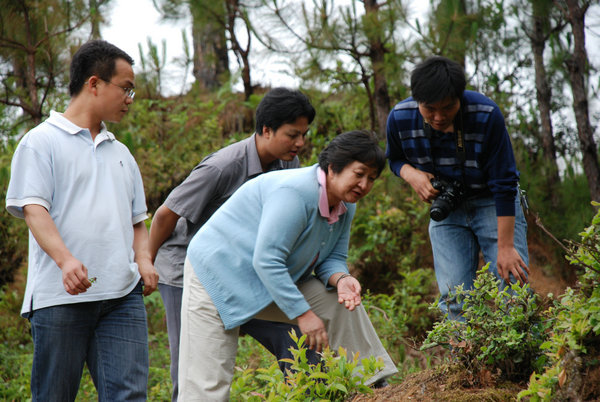
Scientist's journey of discovery takes her into the lush highlands and lowlands of Yunnan to uncover the medical secrets of ethnic groups and share them with the world
For more than three decades, Zhu Zhaoyun has been studying herbs, plants and the bounty of nature, to promote the medicine and medical knowledge of ethnic groups in Southwest China's Yunnan province.
Both far-flung mountains and labs are the battlefield for the 64-year-old senior engineer, who is now the director of the Yunnan Institute of Materia Medica and the research and development director of the listed pharmaceutical company Yunnan Bai Yao Group.
For her outstanding contribution to this field of medicine, Zhu was rewarded 3 million yuan ($476,190) by the provincial government of Yunnan in 2015. Before that, she also received first prize at the National Science and Technology Progress Awards and won a national model worker award in 2012.
In June 1982, Zhu became a member of the Communist Party of China when she was studying at the Yunnan University of Traditional Chinese Medicine. After graduation, she completed a survey of TCM resources in the Dali Bai autonomous prefecture where she worked as a technician at the Dali pharmaceutical factory.
In 1999, the Yunnan Institute of Materia Medica was set to be overhauled into a self-financed State-owned enterprise from a public institute previously funded by the government. Zhu, then 45, was appointed the institute's director, a decision that changed her life.
Difficult start
The institute, one of the 22 research institutes to be overhauled and thereby receive no more fiscal support from the government in 2000, was in desperate need for new medicines, researchers and marketing professionals. Many employees lost hope in the institute's future. At this uncertain time, Zhu took the lead in shouldering the responsibility to revive the institute's fortunes.
Zhu still remembers what the institute was like when she first arrived. "Inside the building were intertwined spider webs and rats jumped out of a drawer when I opened one in the office," she said. "It was a difficult environment to conduct experiments, not to mention research."
Cui Tao, the institute's deputy director, described that year as "a state of poverty and blankness". "Everything was started from scratch and the institute had been weighed down with too many negative things," he said.
Wang Jingkun, executive deputy director of the institute, depicted Zhu as an example of being both pragmatic and hardworking.
To get funds to restart research and the development of new medicines, Zhu began asking for help from every department she could think of. On many occasions she was turned down but there was no time to linger on the embarrassment.
However, her persistence finally paid off when she was granted more than 1 million yuan to renovate the institute's labs. Her journey to produce new ethnic medicines could finally start.





