



Expert: China's actions slowed spread of virus









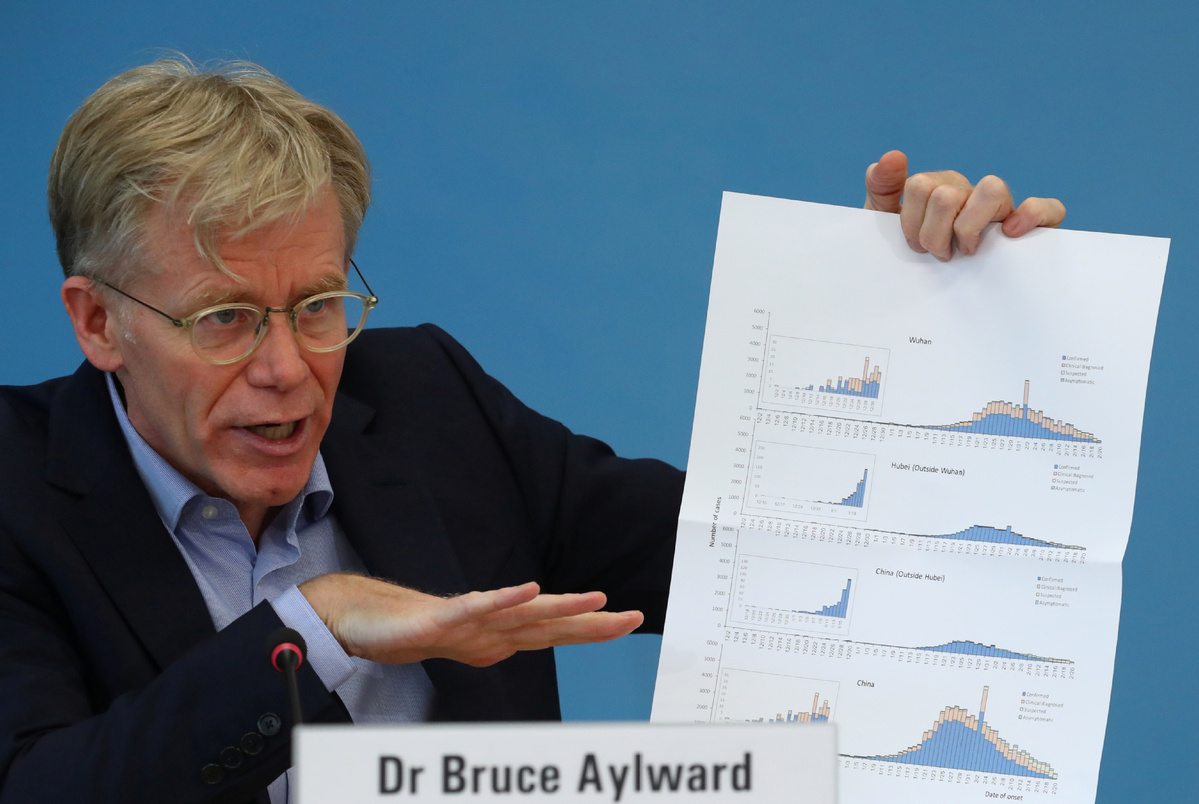
China's mobilization and rapid response to the coronavirus are why the country has seen its number of new cases drop substantially, according to a noted epidemiologist.
Dr Bruce Aylward, leader of a World Health Organization (WHO) team that went to China for two weeks in early February, told The New York Times in an interview published Wednesday how China suppressed the virus outbreak centered in Wuhan, Hubei province.
China's National Health Commission was reporting thousands of new cases on some days, but lately that number has fallen to a couple of hundred.
What China has done could be duplicated in the West, but it will take money and political will, Aylward said in the interview.
He said that containment is still possible "because we don't have a global pandemic — we have outbreaks occurring globally".
According to his bio on the WHO website, Aylward is currently on loan from the organization the United Nations Office for the Coordination of Humanitarian Affairs.
He joined the WHO in 1992 and worked for eight years in immunization, communicable diseases control and polio eradication at the field and regional levels in the Middle East, Western Pacific, Europe, North Africa and Central and Southeast Asia.
A Canadian physician and epidemiologist by training, Aylward is the author of more than 100 peer-reviewed scientific articles and book chapters. He received his medical training in Canada, the London School of Hygiene and Tropical Medicine, and the Johns Hopkins School of Public Health.
Aylward told the Times that "there's this big panic in the West over asymptomatic cases. Many people are asymptomatic when tested, but develop symptoms within a day or two."
He said that in South China's Guangdong province, 320,000 samples originally taken for flu surveillance were retested and that less than 0.5 percent came up positive, which he said was about the same rate as the 1,500 known COVID-19 cases in the province.
"There is no evidence that we're seeing only the tip of a grand iceberg, with nine-tenths of it made up of hidden zombies shedding virus. What we're seeing is a pyramid: most of it is aboveground," Aylward said.
When the Times' interviewer asked him if the cases in China were actually going down, Aylward said: "I know there's suspicion, but at every testing clinic we went to, people would say, ‘It's not like it was three weeks ago.' It peaked at 46,000 people asking for tests a day; when we left, it was 13,000. Hospitals had empty beds.
"Back of the envelope, it's hundreds of thousands of people in China that did not get COVID-19 because of this aggressive response," he said.
Aylward said China also moved 50 percent of all medical care online to avoid contact between doctors and patients.
"Have you ever tried to reach your doctor on Friday night? Instead, you contacted one online. If you needed prescriptions like insulin or heart medications, they could prescribe and deliver it," he said.
Aylward said that the government made testing free, and if one's insurance expired, the state covered all costs.
"In the US, that's a barrier to speed," Aylward said. "People think: ‘If I see my doctor, it's going to cost me $100. If I end up in the ICU (intensive-care unit), what's it going to cost me?' That'll kill you. … This is where universal health care coverage and security intersect. The US has to think this through."
The issue of universal healthcare coverage in the US is a major one in the 2020 Democratic presidential campaign.
As to mass quarantines, Aylward said: "Look, journalists are always saying: ‘Well, we can't do this in our country.' There has to be a shift in mindset to rapid-response thinking. Are you just going to throw up your hands?"
Aylward also said that there was no resentment toward virus epicenter Wuhan, a city of 11 million.
"There was this tremendous sense of, ‘We've got to help Wuhan," not ‘Wuhan got us into this.' … I talked to lots of people outside the system — in hotels, on trains, in the streets at night. They're mobilized, like in a war, and it's fear of the virus that was driving them. They really saw themselves as on the front lines of protecting the rest of China. And the world."


- China-Europe flights emerge as summer travel hotspot
- Blueprint unveiled for Beijing's project 2035
- Summer wheat harvest set to expand nationwide as weather improves
- Legal seminar underscores rule of law in Greater Bay Area integration
- Beijing court sees sharp rise in youth cyber disputes
- Jilin union builds space capsule rest stop for Changchun airport drivers





