



Documentary shows real lives of people in Xinjiang









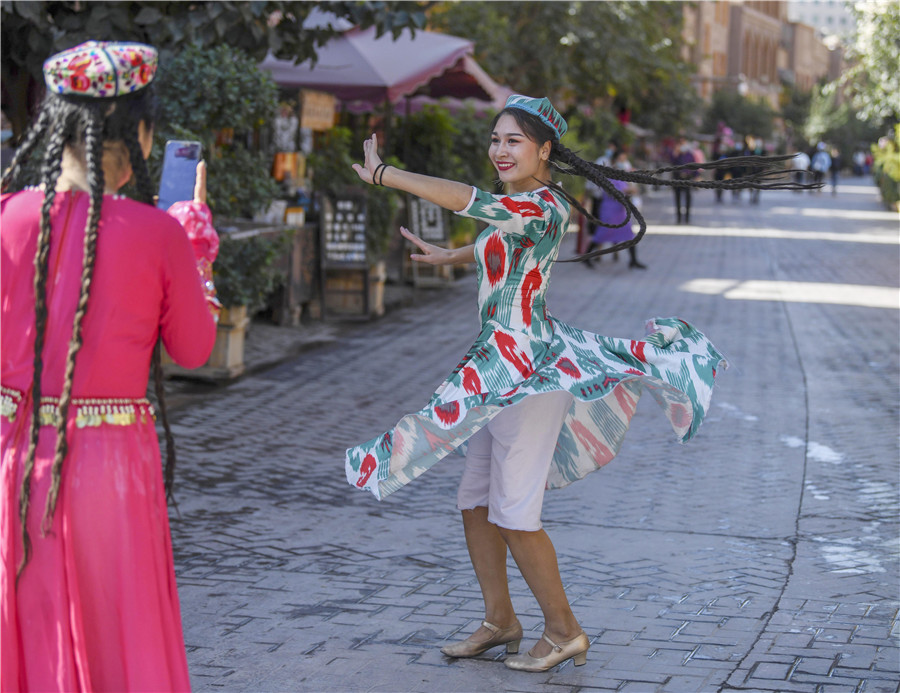
As the fear of terrorism in the Xinjiang Uygur autonomous region subsides and the spread of religious extremism has been effectively curbed, Xinjiang people can freely explore more life options than ever, experts said.
"Xinjiang people from different walks of life have been working hard to find the value of life and contributed to the development of society," said Zhou Weiping, a researcher at the Chinese Academy of Social Sciences' Institute of Chinese Borderland Studies. "The time when people had to live in the shadow of religious extremism and follow its rules is gone."
He made the remarks after watching the 80-minute documentary Beyond the Mountains: Life in Xinjiang, which was first broadcast on Friday on China Global Television Network. It features stories of 24 people, including a cotton grower, a herdsman and the owners of bridal and coffee shops. Their stories chronicle the process of change in the region and its people, who have been trying to balance tradition and new ideas.
"The documentary is about breaking stereotypes and clearing up misconceptions for people in and outside the region. It shows the world the real lives of Xinjiang people, which are nothing like how they are portrayed by certain Western countries," Zhou said.
Zhou, who worked in Xinjiang from 2017 to 2019, said he has witnessed how religious extremism had gradually isolated people from modern society, making them resist the changes brought by social development.
According to the Xinjiang regional government, isolating people from modern society in the name of religion is the key step before extremists, terrorists and separatists can groom people to carry out violent attacks.
Samira Arkin, from Kashgar in southern Xinjiang, shared her story in the documentary about why she wanted to open a bridal shop. When she returned to Kashgar in 2010 after graduating from a university, she was sad to see that many women had no choice but to cover themselves up because of religious extremism. What's more, some even had no right to go out when they wanted to, Samira said.
Although many people at the time believed that wearing white bridal gowns at weddings was inappropriate behavior, Samira still decided to open the bridal shop in 2014 because she wanted to give women options and let them know it's their right to choose what to wear.
"Now women in Kashgar are independent. They know what they want," Samira said.
The stories of Xinjiang people, especially young people, have shown how traditions and modern lives are integrated in the region, said Wu Dingming, a professor at Fujian Normal University's School of Communication.


- Summer wheat harvest set to expand nationwide as weather improves
- Legal seminar underscores rule of law in Greater Bay Area integration
- Beijing court sees sharp rise in youth cyber disputes
- Jilin union builds space capsule rest stop for Changchun airport drivers
- Power restored in Chongqing district after 296mm two-hour deluge
- Scientists create first comprehensive map of early human embryo development





