



Advisers foresee Shanghai as humanoid robotics hub









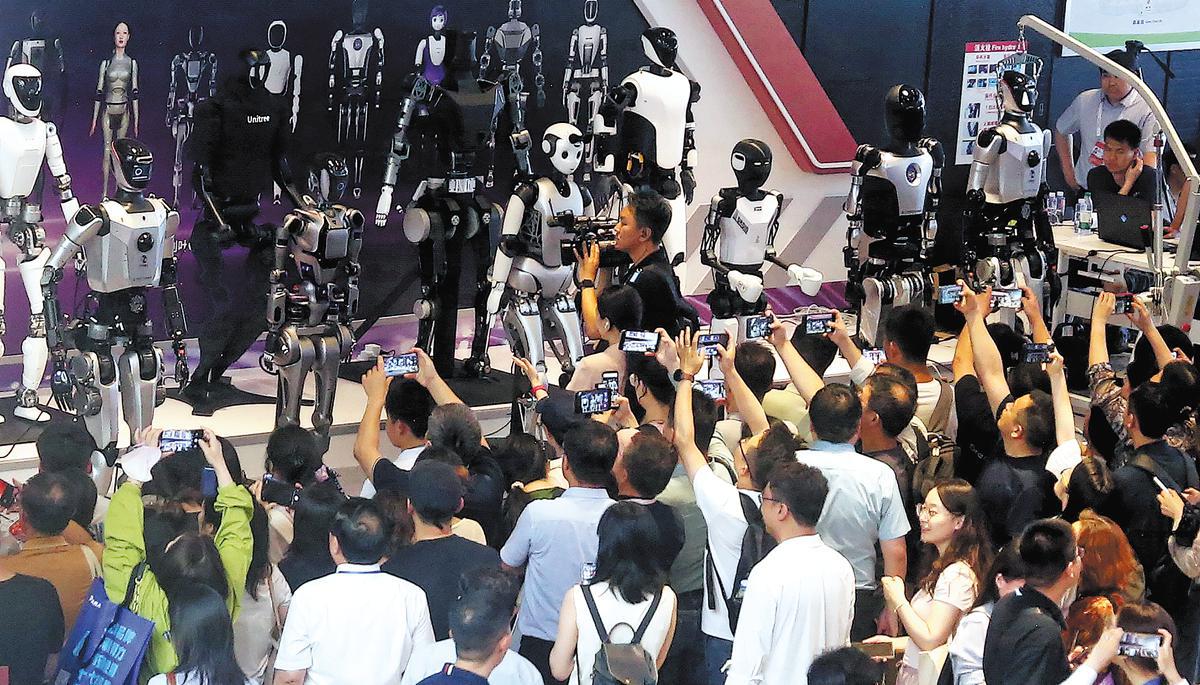
Political advisers in Shanghai have suggested advancing the industrialization of humanoid robotics in the city, leveraging its strengths in artificial intelligence and robotics. They said Shanghai is well-positioned to lead the large-scale application of humanoid robots in China.
Addressing the current challenges the industry is facing in the metropolis, including a lack of core components and reliance on imported key functional parts, members of the Shanghai Committee of the Chinese People's Political Consultative Conference proposed nurturing a high-end industrial chain and supporting collaboration among industry, academia and research institutions to achieve joint technological breakthroughs.
The advisers submitted proposals related to the humanoid robotics industry during the ongoing annual sessions of the city's legislative and political advisory bodies, which will run through Saturday.
Industry insiders have highlighted the potential significance of humanoid robots in various sectors, including manufacturing, hazardous environments, healthcare, elderly care services and underwater scientific research. For instance, in industrial settings, such robots could enhance work efficiency, particularly in enterprises requiring repetitive tasks with high precision.
The robots could function as a tool for doctors in performing precision surgeries, and key parts such as robotic arms could serve as prosthetics, enabling individuals with disabilities to return to normal life and work.
In October 2023, Shanghai set a goal to establish itself as a globally influential hub for robotics innovation. The initiative includes creating 10 top-tier robot brands, showcasing 100 bench mark scenarios for robot applications and expanding the value of related industries to 100 billion yuan ($13.63 billion) in the coming years.
Political advisers from the Shanghai Federation of Industry and Commerce suggested accelerating research and development in areas such as motors, drivers, sensors and main controller chips for humanoid robots. Another proposal, submitted by advisers from the Shanghai Association for Science and Technology, emphasized the need to bridge gaps in precision, life span and reliability between domestic products and their overseas counterparts.
"Local research has made certain advances in motion control processing, environmental perception and decision-making algorithms for human-computer interaction, but further progress is needed to meet diverse needs. Additionally, the intelligence level of machine vision learning models requires improvement," the advisers wrote in a collective proposal.
They also recommended that multiple enterprises share resources and establish a data bank containing information on robot actions and knowledge. By building a joint computing power center and developing multimodal large models, enterprises could reduce R&D costs, they suggested.
A joint proposal by 12 political advisers highlighted the importance of verifying the characteristics, feasibility and economic value of humanoid robots in various scenarios and creating a detailed list of areas where such robots could have a significant impact. Enterprises could then develop their core technologies accordingly.
The advisers outlined a commercialization path for humanoid robots, starting with niche applications and gradually expanding to mass markets.
"After being deployed in specific application scenarios, the robots can transition to semi-open environments such as warehousing, retail and catering, performing semi-automated tasks like carrying and distributing items," said Zhang Jianhua, one of the political advisers involved in drafting the proposal.
"For the next phase, the robots will be promoted to provide services such as housekeeping support and health management in settings like homes, offices, elderly care facilities and hotels. Eventually, they will be more widely used in daily life and workplaces," said Zhang, who is also vice-president of Shanghai University.
zhouwenting@chinadaily.com.cn


- Hebei's updated tree protection rules take effect July 1
- Hebei's Yishui Lake offers cool summer escape amid mountain scenery
- Sino-British dialogue explores waterfront urban development
- China calls for vigilance against remilitarized Japan
- Gansu farmer 'Field Mouse Auntie' reads, writes and records village life
- China pioneers intelligent transport systems for enhanced safety and efficiency





