



Technology helps to clean up a dirty business









Pilot programs
Beijing has been piloting garbage sorting since 2000, but has yet to see marked progress.
Liu Quan, Tiantianjie's general manager who has worked in the garbage-recycling industry since 2005, said the capital's previous efforts failed mainly because there was no monitoring system to assess progress and officials failed to identify the core necessities of trash-sorting programs.
In 2000, the government hired garbage-sorting "instructors", who worked at dumping sites in communities helping residents to dispose of different types of trash correctly. However, authorities found it difficult to supervise their work, and when officials conducted inspections, they mainly checked to see if the facilities were orderly and there were clear identifiers to facilitate the disposal of sorted trash.
Moreover, the volume of sorted trash, which should have been a key factor in the assessment program, was not included in the inspectors' lists, Liu said.
Now, the internet is addressing many of those problems via garbage-sorting databases, which allow the volume of sorted waste to be assessed efficiently and help people to realize that their efforts are not in vain, he added.
Liu said too much attention has been paid to the "front-end" of the garbage-dumping process. For example, many communities have introduced smart facilities which can only be opened when residents scan QR codes with their smartphones, while others have even built attractive facilities to serve as dumping sites. However, irrespective of their appearance, they still only house garbage bins.
"Garbage sorting requires a complex network that goes far beyond these simple measures - an efficient logistics system is key because the garbage needs to be transported after being sorted," he said.
However, China's high population density means it is difficult to establish such logistics systems. Garbage bins in communities can fill up quickly and it can be difficult to transport the trash promptly.
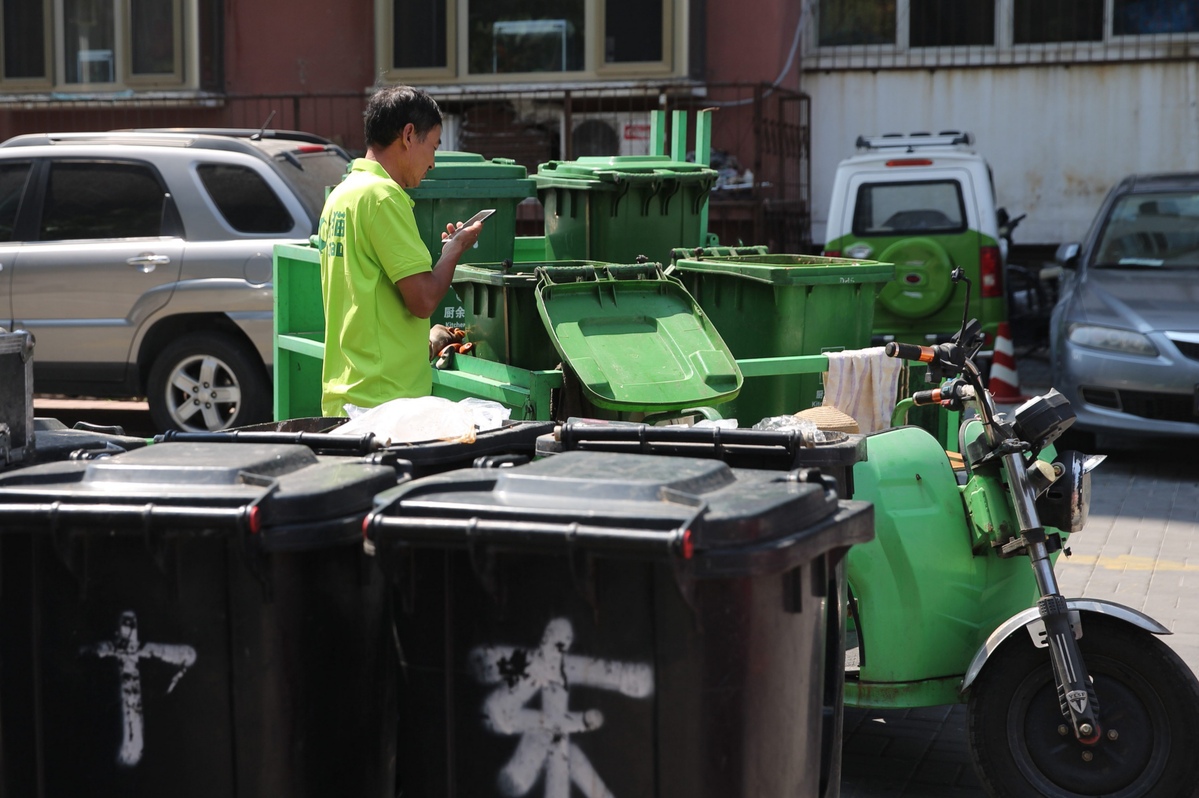
Ironically, according to Liu, those factors are advantageous for his company. He said the government pays Tiantianjie to separate waste which has been deposited haphazardly in green trash cans - intended purely for kitchen leftovers - in Donghuashi and Temple of Heaven streets, which are home to about 46,000 households.


- UK companies seeking larger role in China
- Defense spokesman says Japan risks becoming 'source of turmoil' in East Asia
- Patients as pioneers: A doctor changes cancer research in China
- China-Europe flights emerge as summer travel hotspot
- Blueprint unveiled for Beijing's project 2035
- Summer wheat harvest set to expand nationwide as weather improves





