



Expedition goes deep to safeguard Shuanghe Cave









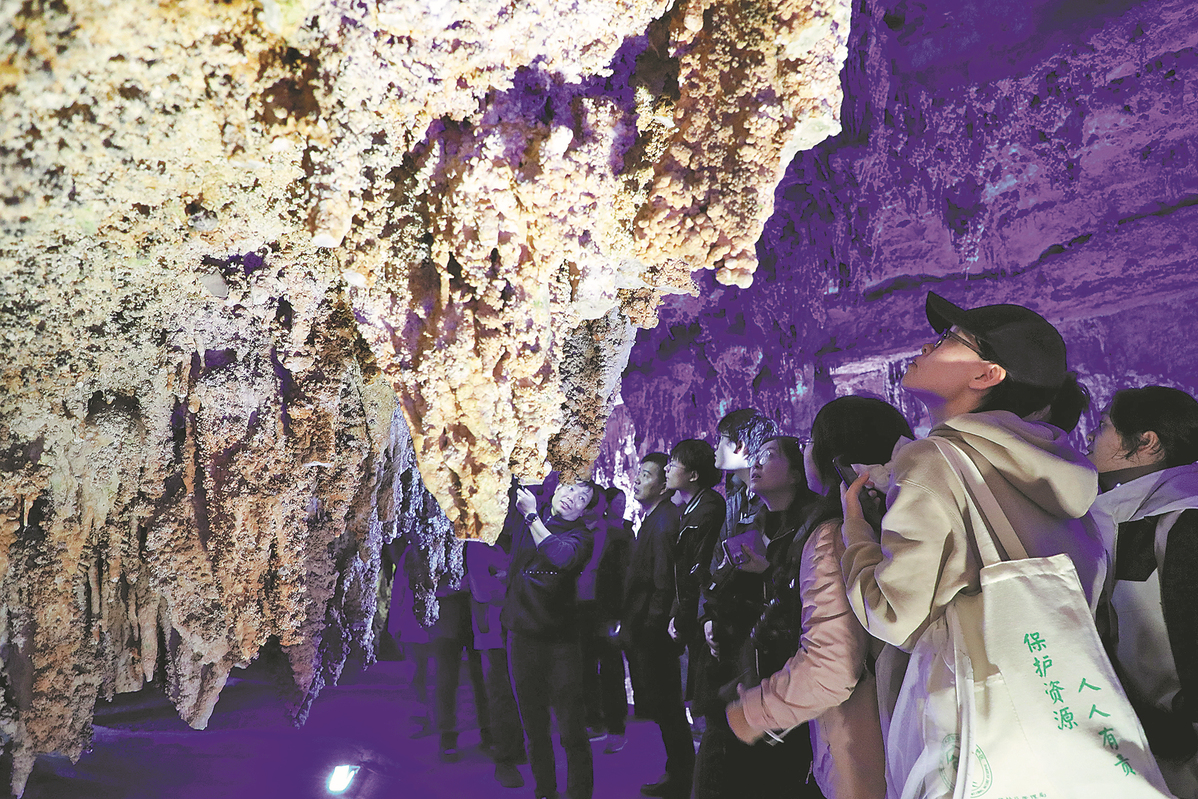
Beijing Forestry University students and teachers recently took part in a "crossover expedition" in Asia's longest cave in Guizhou province, conducting experiments with experts to better understand and protect its rare ecosystem.
A previous survey of Shuanghe Cave conducted by an international team of experts that was released in September this year, showed it to be 409.9 kilometers long and 912 meters deep.
Zhou Wenlong, deputy director of the Guizhou Institute of Mountain Resources and an official with the Geological Society of China's Committee on Speleology, said during 35 years of scientific expeditions in Shuanghe Cave, international experts have discovered 40 giant panda fossils and geological relics of celestite.
"It is the longest dolomite cave with the largest celestine area in the world," Zhou said, adding that the cave is described as a "karst natural cave museum".
Zhou also led the students' crossover expedition to the cave in late November. He said they conducted simple experiments with diluted hydrochloric acid to examine the chemical dissolution of carbonate rocks in the karst landscape.
Li Hanqing, a postgraduate student who participated in the expedition, wrote about the experience in her journal.
"We can see that water plays an indispensable role in the formation of caves. Water promotes the development of caves, and also erodes caves," Li said.
"A unique landscape is formed in the cave thanks to the participation of water and carbon dioxide. First, a type of rock 'soda straw' is generated. Then stalactites and stalagmites are formed, and later connected to become stone column."
Although the eight university students and teachers are not experts in the field of speleology, they still found something familiar in the caves — lampenflora, autotrophic life-forms present in natural and artificial caves.
Installed lighting in show caves — those open to the public for observation — can cultivate plants, which can grow if they have enough artificial light and moisture.
Zhou said lampenflora is a big problem for researchers as it changes the appearance of show caves and leaves visitors with the wrong impression of natural caves.
Acids secreted by lampenflora can also cause damage to rocks, disturbing a cave's ecology, he added.
"I hope these students and teachers can try fixing the problem of light plants through their forestry studies," Zhou said.


- UK companies seeking larger role in China
- Defense spokesman says Japan risks becoming 'source of turmoil' in East Asia
- Patients as pioneers: A doctor changes cancer research in China
- China-Europe flights emerge as summer travel hotspot
- Blueprint unveiled for Beijing's project 2035
- Summer wheat harvest set to expand nationwide as weather improves





